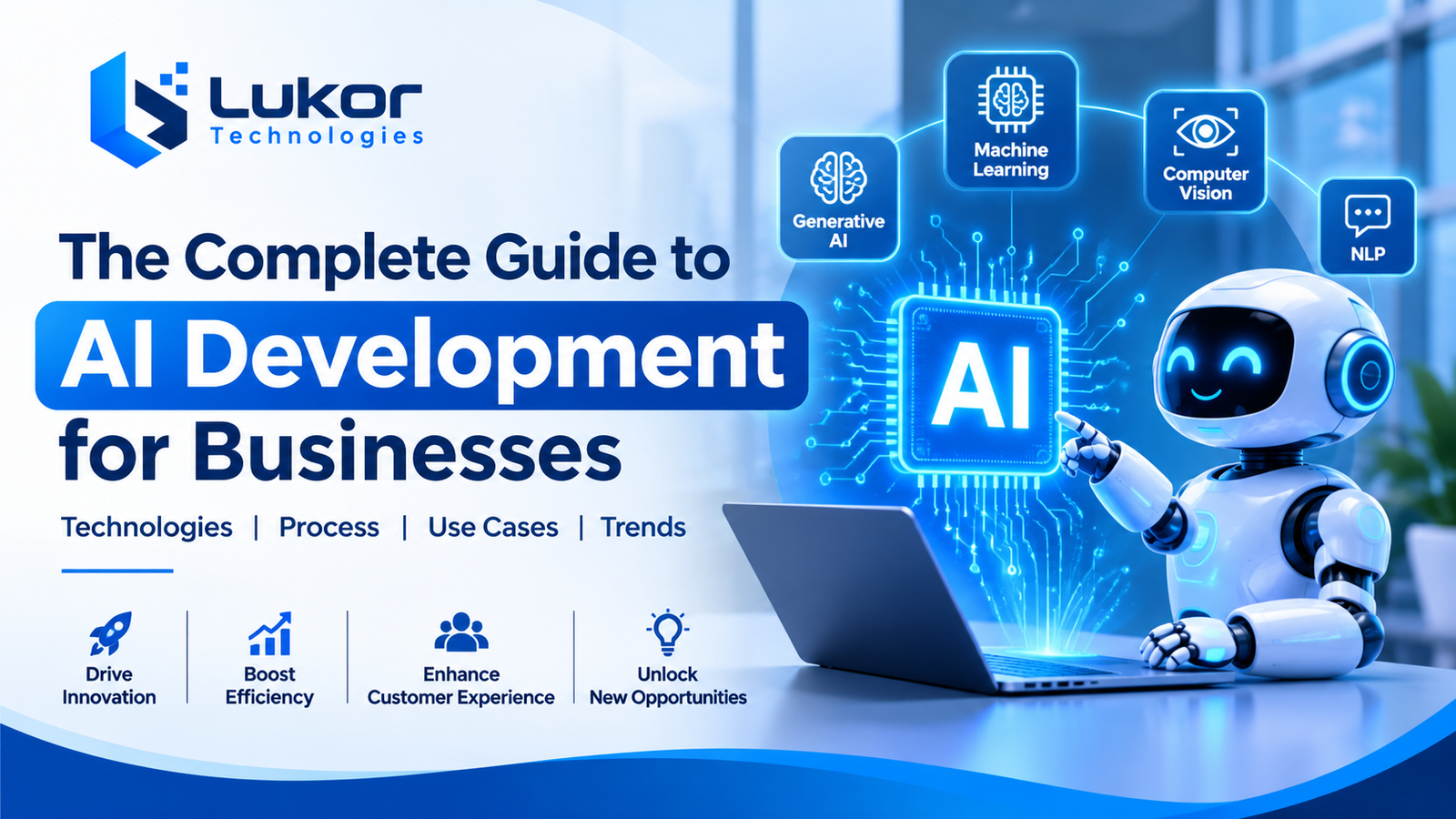
Artificial intelligence (AI) is transforming how businesses operate, make decisions, serve customers and develop digital products. Through AI development, organizations can automate repetitive tasks, analyze complex data, improve operational efficiency and build smarter digital solutions.
The growing adoption of AI reflects its increasing business value. The global AI market was valued at approximately $255 billion in 2025 and is projected to exceed $1.2 trillion by 2030, highlighting the expanding demand for AI technologies and applications.
As businesses look toward 2027, technologies such as machine learning, generative AI, computer vision and agentic AI are creating new opportunities to streamline workflows, personalize customer experiences and drive innovation. However, successful AI implementation requires more than adopting advanced tools. It depends on reliable data, suitable technologies, secure architecture and clearly defined business goals.
This guide covers everything businesses need to know about AI development, including its types, technologies, architecture, development process, real-world applications, benefits, costs, challenges, best practices and emerging trends.
What Is AI Development?
AI development is the process of creating software applications and systems that use artificial intelligence to analyze data, recognize patterns, make predictions, understand language and generate responses.
Unlike traditional software, which primarily follows predefined rules and instructions, AI-powered systems use trained models and data to produce outputs based on the information they receive.
For example, a traditional customer support system follows fixed responses based on predefined conditions. An AI-powered chatbot can understand customer questions, identify their intent and generate relevant responses using natural language processing and large language models.
AI development involves technologies such as machine learning, deep learning, computer vision, natural language processing and generative AI. The right approach depends on business requirements, available data, technical constraints and application goals.
How AI Development Works
AI development typically involves collecting and preparing data, selecting suitable algorithms or pre-trained models, developing the application and evaluating its performance.
Depending on the solution, developers may train a model using business data, customize an existing model or integrate an AI service through an API.
The resulting application processes new information and generates predictions, recommendations, classifications or other outputs.
For example, an e-commerce business can use AI to analyze browsing behavior and purchase history to recommend products based on individual customer preferences.
The Role of Artificial Intelligence in Modern Businesses
Businesses use artificial intelligence to automate tasks, analyze information and improve everyday operations.
Common applications include:
- Analyzing customer behavior and purchasing patterns.
- Automating repetitive administrative tasks.
- Forecasting inventory and product demand.
- Personalizing marketing and product recommendations.
- Detecting unusual transactions and potential security threats.
- Supporting customers through intelligent chatbots.
- Extracting information from business documents and databases.
- Generating reports and assisting employees with internal knowledge searches.
Rather than replacing existing software, AI often enhances it with intelligent capabilities that help employees work more efficiently and make informed decisions.
AI Development vs. Traditional Software Development
Traditional software development relies on predefined rules, instructions and workflows. AI software development uses trained models to identify patterns, learn from data and handle tasks that may be difficult to solve through fixed rules alone.
For example, a traditional inventory system calculates stock levels using predefined formulas. An AI-powered inventory application can analyze historical sales, seasonal patterns and other relevant information to forecast future demand.
Both approaches have important advantages. Traditional software provides predictable business logic, while AI can support complex analysis, predictions and content generation.
Combining traditional software engineering with AI capabilities helps businesses build intelligent, reliable and scalable applications.
Why Is AI Development Important for Businesses in 2027?
Businesses face growing data volumes, changing customer expectations and increasing pressure to improve operational efficiency. AI development helps address these challenges through intelligent automation, data analysis and personalized digital experiences.
Here are six important reasons businesses are investing in AI-powered solutions.
1. Automating Repetitive Business Operations
AI-powered automation helps businesses reduce manual work involved in tasks such as data entry, document processing, appointment scheduling and customer inquiry management.
For example, an AI document processing application can extract information from invoices, categorize documents and transfer relevant details to accounting software.
This reduces repetitive administrative work and allows employees to focus on more valuable responsibilities.
2. Improving Data-Driven Decision-Making
AI systems can analyze large datasets, identify patterns and generate predictions that support better business decisions.
For example, retail businesses can use predictive analytics to identify purchasing trends, understand seasonal demand and improve inventory planning.
3. Enhancing Customer Experiences
AI-powered chatbots, recommendation engines and virtual assistants help businesses respond to customer questions, suggest relevant products and provide faster support.
These systems can also analyze customer preferences and previous interactions to deliver more personalized experiences.
4. Increasing Operational Efficiency and Productivity
AI helps employees save time by automating routine activities, organizing information and supporting everyday workflows.
For example, AI applications can summarize documents, classify customer requests, generate reports and retrieve information from internal knowledge bases.
5. Supporting Business Growth and Scalability
As businesses grow, AI-powered systems can help manage larger workloads, process more information and support increasingly complex operations.
Cloud infrastructure, modular application architecture and automated workflows make it easier to expand AI capabilities as business requirements evolve.
6. Enabling New Products and Business Opportunities
AI creates opportunities to develop new digital products and improve existing services.
Businesses can introduce intelligent assistants, predictive analytics platforms, personalized customer applications and AI-powered business tools to address changing market needs.
What Are the Different Types of AI Development?
AI development includes several technologies, each designed to solve different problems based on business requirements, available data and application goals.
The main types include machine learning, deep learning, generative AI, natural language processing, computer vision and agentic AI.
1. Machine Learning Development
Machine learning enables systems to learn patterns from data and make predictions or decisions without manually programming every rule.
Businesses use machine learning for:
- Customer behavior prediction.
- Fraud detection.
- Product recommendations.
- Sales forecasting.
- Predictive maintenance.
- Customer segmentation.
- Demand prediction.
For example, financial institutions use machine learning models to analyze transactions and identify potentially suspicious activities.
2. Deep Learning Development
Deep learning is a branch of machine learning that uses multi-layered neural networks to identify complex patterns in large datasets.
It is commonly used for image recognition, speech processing, autonomous systems and advanced language models.
Businesses can use deep learning to recognize objects in images, process voice commands, analyze visual information and develop intelligent applications.
3. Generative AI Development
Generative AI development focuses on building applications that create new content, such as text, images, audio, video and code, based on user instructions.
It commonly uses large language models and other generative models to produce contextually relevant outputs.
Common business applications include:
- AI-powered content generation.
- Customer support assistants.
- Document summarization.
- Code assistance.
- Marketing content creation.
- Internal knowledge management.
- Intelligent research applications.
For example, a business can develop a generative AI application that searches internal documents and provides employees with relevant answers.
4. Natural Language Processing Development
Natural language processing (NLP) enables computers to understand, interpret and process human language.
It supports applications such as:
- Sentiment analysis.
- Text classification.
- Language translation.
- Chatbots and virtual assistants.
- Document analysis.
- Customer feedback processing.
- Information extraction.
For example, businesses can use NLP to analyze customer reviews, identify common complaints and understand customer preferences.
5. Computer Vision Development
Computer vision enables software to analyze and interpret visual information from images and videos.
Common applications include:
- Object and facial recognition.
- Manufacturing quality inspection.
- Medical image analysis.
- Retail shelf monitoring.
- Security monitoring.
- Automated document recognition.
- Visual inventory management.
For example, manufacturers can use computer vision to detect product defects during quality inspections.
6. Agentic AI Development
Agentic AI development involves building AI systems that can plan tasks, use connected tools and complete multi-step workflows toward defined goals, with varying levels of human supervision.
Unlike basic chatbots, AI agents can retrieve information, interact with business applications and perform authorized actions.
Common business applications include:
- Automated customer service workflows.
- Research and information gathering.
- IT support assistance.
- Business process coordination.
- Workflow automation.
- Internal operational support.
- Information retrieval and task execution.
Because these systems can interact with business tools and data, they require controlled permissions, activity monitoring, testing and human oversight.
How to Identify the Right AI Opportunities for Your Business
Before investing in AI development, businesses should identify where artificial intelligence can deliver measurable value.
The best opportunities usually involve solving specific operational problems, improving customer experiences or increasing efficiency.
Identify Repetitive and Time-Consuming Tasks
Review daily operations to find activities that require significant manual effort, such as invoice processing, customer inquiry management, appointment scheduling and document review.
These tasks may be suitable for AI-powered automation.
Evaluate Available Business Data
AI applications rely on relevant and reliable data. Review information collected through CRM platforms, ERP systems, websites, mobile applications and internal databases.
Check whether the data is accurate, accessible, secure and suitable for the intended application.
Define Clear Implementation Goals
Set specific objectives for every AI project, such as reducing document processing time, improving customer response times or increasing sales forecasting accuracy.
Clear goals help guide technology selection and measure project performance.
Assess Business Value and Potential ROI
Evaluate the expected benefits against development, infrastructure, integration and maintenance costs.
Consider measurable outcomes such as operating expenses, processing time, error rates, customer satisfaction and employee productivity to determine whether the investment is worthwhile.
Start With a Small AI Pilot Project
Begin with a limited project to test performance, integration requirements and practical business value before expanding across the organization.
A successful pilot provides a stronger foundation for wider AI implementation.
How Does the AI Development Process Work?
The AI development process involves several stages, from defining business requirements to deploying and maintaining the final application.
A structured approach helps ensure the solution meets business needs and performs reliably in real-world environments.
Step 1. Identify Business Requirements and Project Goals
Start by understanding the business problem and defining what the AI application should achieve.
Development teams identify key requirements, including:
- Business objectives and target users.
- Required features and workflows.
- Data availability and quality.
- Performance expectations.
- Security and compliance needs.
- Project scope and budget.
- Integration requirements.
For example, a business planning to develop an AI-powered customer support platform may prioritize response accuracy, customer data protection and integration with its existing CRM system.
Clear goals help keep development focused and avoid unnecessary work.
Step 2. Collect and Prepare Relevant Data
AI applications rely on relevant and reliable data. Depending on the project, this may include databases, documents, images, videos or audio files.
Data preparation involves:
- Cleaning inaccurate records.
- Removing duplicate information.
- Organizing datasets.
- Labeling information when required.
- Addressing missing values.
- Checking data quality and consistency.
- Applying appropriate privacy and access controls.
For generative AI applications, teams may also prepare internal documents and knowledge sources for retrieval-based systems.
Step 3. Select the Right AI Models and Technologies
The choice of AI technology depends on the application’s purpose and technical requirements.
For example, a recommendation engine may use machine learning, while an intelligent document assistant may combine a large language model with retrieval-augmented generation (RAG).
Developers evaluate models based on:
- Accuracy and output quality.
- Data privacy and security.
- Integration capabilities.
- Processing speed and latency.
- Infrastructure requirements.
- Scalability.
- Licensing and operating costs.
Depending on the project, teams may use pre-trained, fine-tuned, open-source or custom-trained models.
Step 4. Design the AI Application Architecture
Before implementation, development teams define how the AI model, application backend, databases, APIs and user interface will work together.
Architecture planning helps establish secure data flows, integration methods, infrastructure requirements and system responsibilities.
For example, an enterprise AI assistant may require a frontend application, backend services, an LLM API, a vector database and access to approved internal documents.
The architecture should also account for authentication, permissions, monitoring, error handling and future scalability.
Step 5. Develop and Train AI Models
At this stage, developers build the application and configure the selected AI models.
Depending on the requirements, development may involve:
- Model training.
- Fine-tuning.
- Prompt engineering.
- Retrieval-augmented generation.
- Application development.
- API integration.
- Workflow configuration.
For example, a predictive maintenance system can analyze historical equipment data to identify patterns associated with potential failures.
Not every AI solution requires training a model from scratch. Many applications use existing models customized through prompts, retrieval systems or fine-tuning.
Step 6. Test and Evaluate AI Performance
Testing ensures the AI solution meets performance, reliability and security requirements.
Key evaluation areas include:
- Accuracy and output quality.
- Response relevance and consistency.
- Processing speed and latency.
- Security and data privacy.
- Bias and fairness.
- Performance under different conditions.
- Integration reliability.
- Infrastructure usage and operating costs.
For generative AI applications, testing should also check for hallucinations, prompt injection vulnerabilities and unsupported responses.
Development teams should use representative evaluation datasets and test cases before releasing the application.
Step 7. Integrate and Deploy AI Solutions
After testing, developers integrate the AI application with existing business systems, such as CRM platforms, ERP software, websites, mobile applications and databases.
This stage also involves configuring:
- APIs and data connections.
- Authentication and access controls.
- Cloud infrastructure.
- Deployment environments.
- Logging and monitoring.
- Backup and recovery procedures.
A controlled deployment process helps ensure a secure and smooth launch.
Step 8. Monitor, Maintain and Improve AI Systems
AI development continues after deployment. Regular monitoring helps identify performance issues and keep applications aligned with changing business requirements.
Ongoing maintenance may include:
- Monitoring model performance and output quality.
- Updating datasets and AI models when needed.
- Tracking model drift.
- Managing API and technology changes.
- Improving application functionality.
- Addressing security vulnerabilities.
- Monitoring infrastructure and operating costs.
- Reviewing user feedback.
Continuous improvement helps maintain the reliability, security and long-term value of AI-powered applications.
What Is the Architecture of an AI-Powered Application?
AI application architecture defines how different software components work together to collect data, process requests, generate intelligent outputs and deliver results to users.
A well-designed architecture supports performance, security, scalability and reliable integration with existing business systems.
Although architecture varies by application, most AI-powered solutions include the following components.
1. Data Sources and Collection
The data layer collects information from databases, business applications, documents, APIs, websites and other approved sources.
The quality and relevance of this information directly influence the performance of AI applications.
2. Data Processing and Storage
Collected information is cleaned, organized and prepared for use by the AI system.
Depending on the application, data may be stored in relational databases, document databases, cloud storage or specialized data platforms.
3. AI Models and Inference Layer
This layer contains the AI models responsible for processing information and generating outputs.
It may include machine learning models, large language models, computer vision models or external AI services.
Inference refers to using a trained model to process new inputs and generate predictions or responses.
4. Backend Services and API Integration
Backend services connect the AI model with the rest of the application.
They manage business logic, user requests, authentication, data access, API communication and workflow execution.
For example, an AI-powered CRM application may use backend APIs to retrieve customer information and generate relevant sales insights.
5. Frontend and User Interface
The frontend provides the interface through which users interact with the AI application.
Depending on the project, this may include a web application, mobile application, dashboard, chatbot interface or internal business portal.
6. Cloud Infrastructure and Deployment
Cloud infrastructure provides the computing resources required to run AI models, store information and manage application workloads.
Businesses may use managed AI services, cloud virtual machines, containers or Kubernetes-based environments depending on their requirements.
7. Security, Monitoring and Governance
Security and monitoring components protect application data and help maintain reliable operations.
These may include:
- Identity and access management.
- Encryption and secure communication.
- Activity logging and audit trails.
- Model performance monitoring.
- Usage and cost monitoring.
- Output validation.
- Human approval workflows.
- Security and compliance reviews.
Example: Architecture of an AI-Powered Business Assistant
An AI business assistant can combine a frontend interface, backend application services, a large language model and a retrieval system connected to approved business documents.
When an employee asks a question, the application retrieves relevant information, sends the appropriate context to the AI model and returns a generated response.
This approach can help employees access company policies, product documentation and internal knowledge more efficiently.
Essential AI Development Technologies, Tools and Frameworks
Choosing the right technology stack is essential for successful AI development. The selection depends on application requirements, data availability, project complexity and deployment needs.
Businesses exploring artificial intelligence can also benefit from using the right AI tools to streamline workflows, automate tasks, improve productivity and support application development. Choosing suitable tools depends on business requirements, technical capabilities and intended use cases. Explore our guide to the [best AI tools] to discover popular solutions for different business needs.
Programming Languages for AI Development
- Python: Widely used for AI and machine learning development, data processing, model training and integration with AI services.
- Java: Suitable for enterprise AI applications, backend development and integration with large-scale business systems.
- R: Commonly used for statistical computing, data analysis, research and data visualization.
- JavaScript and TypeScript: Useful for building AI-powered web applications, frontend interfaces and backend services that integrate with AI APIs.
Popular AI Development Frameworks and Libraries
- TensorFlow: An open-source framework for building, training and deploying machine learning and deep learning models.
- PyTorch: Widely used for deep learning, neural networks, research and production applications.
- Scikit-learn: Provides tools for traditional machine learning tasks such as classification, regression, clustering and model evaluation.
- Keras: Offers a high-level interface for building and training neural networks.
- Hugging Face Transformers: Provides tools and access to pretrained models for natural language processing and other machine learning tasks.
Generative AI Models and Platforms
- Large Language Models (LLMs): Power applications such as intelligent assistants, document analysis, content generation and conversational interfaces.
- OpenAI Models: Provide AI capabilities for building applications involving text, reasoning, image understanding and other supported tasks.
- Google Gemini: Supports multimodal AI applications involving text, images, audio and other supported information types.
- Hugging Face: Offers model repositories, libraries and tools for exploring, customizing and deploying AI models.
RAG, Vector Databases and AI Integration Tools
- LangChain: Helps developers connect language models with data sources, tools and application workflows.
- LlamaIndex: Provides tools for connecting LLM applications with external data and knowledge sources.
- Pinecone: A vector database platform used for similarity search and retrieval applications.
- Weaviate: Supports vector search and semantic information retrieval.
- PostgreSQL with pgvector: Enables vector similarity search alongside relational application data.
These technologies can support retrieval-augmented generation, semantic search and knowledge-based AI assistants.
Cloud Platforms for AI Development
- Amazon Web Services (AWS): Provides cloud infrastructure and managed AI services for developing, deploying and scaling AI applications.
- Microsoft Azure: Offers cloud infrastructure, AI services and machine learning tools for enterprise applications.
- Google Cloud Platform (GCP): Provides computing infrastructure, data services and AI tools for building and deploying intelligent solutions.
Cloud platforms help businesses manage computing resources, deploy AI applications and scale infrastructure as their requirements grow.
The right technology stack should be selected based on performance, security, integration requirements, developer expertise and long-term operating costs rather than popularity alone.
Top AI Applications and Use Cases Across Industries
AI development helps businesses across industries improve operations, analyze information and deliver better customer experiences.
The following examples demonstrate how organizations can apply artificial intelligence to practical business requirements.
AI Development for Healthcare
Healthcare organizations use AI to support administrative tasks, analyze medical information and improve operational efficiency.
Common applications include:
- Medical image analysis support.
- Appointment scheduling automation.
- Patient communication assistants.
- Healthcare document processing.
- Hospital resource management.
- Clinical data analysis.
- Patient information retrieval.
For example, an AI-powered healthcare application can help organize patient documentation and support administrative workflows.
Clinical AI applications require appropriate validation, data privacy safeguards and healthcare professional oversight. AI-generated outputs should not replace qualified clinical judgment.
AI Solutions for Finance and Banking
Financial institutions use AI to analyze transactions, manage risks and improve customer services.
Common applications include:
- Fraud detection and transaction monitoring.
- Credit risk analysis.
- Customer support automation.
- Financial forecasting.
- Document verification.
- Suspicious activity identification.
For example, machine learning models can analyze transaction patterns and flag potentially unusual activities for further investigation.
AI outputs require careful evaluation when they influence financial decisions or customer eligibility.
AI Development for Retail and E-commerce
Retail businesses use AI to understand customer preferences, personalize shopping experiences and improve inventory management.
Common applications include:
- Personalized product recommendations.
- AI-powered shopping assistants.
- Customer behavior analysis.
- Demand forecasting.
- Inventory optimization.
- Automated product categorization.
- Intelligent customer support.
For example, an e-commerce platform can recommend relevant products based on browsing behavior, purchase history and product preferences.
AI Solutions for Manufacturing
AI helps manufacturers improve production processes, monitor equipment and maintain product quality.
Common applications include:
- Predictive maintenance.
- Automated visual inspection.
- Production forecasting.
- Equipment performance analysis.
- Supply chain optimization.
- Process automation.
For example, computer vision systems can identify product defects during manufacturing inspections, while predictive models can help identify equipment maintenance requirements.
AI Development for Education
Educational institutions can use AI to support personalized learning and simplify administrative activities.
Common applications include:
- Personalized learning recommendations.
- Intelligent tutoring assistants.
- Automated administrative support.
- Learning progress analysis.
- Educational content organization.
- Student support chatbots.
AI should complement educators rather than replace their role in important learning decisions.
AI Applications in Logistics and Transportation
Logistics companies use AI to improve delivery planning, fleet management and supply chain operations.
Common applications include:
- Route optimization.
- Delivery time prediction.
- Fleet monitoring.
- Demand forecasting.
- Warehouse automation.
- Shipment tracking assistance.
For example, AI-powered logistics platforms can analyze delivery history and operational information to help identify more efficient routes.
AI Solutions for Real Estate
Real estate businesses can use AI to improve property discovery, analyze market information and manage customer inquiries.
Common applications include:
- Property recommendation systems.
- Automated lead qualification.
- Property price analysis.
- Intelligent virtual assistants.
- Document processing.
- Customer behavior analysis.
For example, a real estate platform can recommend properties based on customer preferences, location requirements and previous searches.
Custom AI Development vs. Ready-Made AI Solutions
Businesses can adopt artificial intelligence through prebuilt platforms or custom applications developed around their specific requirements.
The right approach depends on business goals, budget, technical needs and long-term plans.
What Is Custom AI Development?
Custom AI development involves building AI-powered applications tailored to a business’s workflows, data and functional requirements.
It may include developing machine learning models, integrating existing AI models and connecting intelligent features with business systems.
For example, a logistics company can develop a custom AI solution to analyze shipment data and delivery history to improve route planning.
What Are Ready-Made AI Solutions?
Ready-made AI solutions are prebuilt platforms and applications that provide AI functionality without requiring development from scratch.
Examples include AI writing assistants, customer support platforms, document processing tools and predictive analytics services.
They are useful for businesses that need standard AI capabilities and want faster implementation.
Key Differences Between Custom and Ready-Made AI
| Comparison factor | Custom AI development | Ready-made AI solutions |
|---|---|---|
| Customization | Designed around specific requirements | Usually offers predefined features |
| Implementation | Requires planning and development | Generally quicker to adopt |
| Integration | Can be tailored to business systems | Depends on available integrations |
| Initial investment | Often higher | Often lower |
| Control | Greater control over application design | Limited by provider capabilities |
| Scalability | Can be designed for specialized needs | Depends on platform capabilities |
| Maintenance | Requires ongoing technical support | Often includes provider-managed updates |
Which AI Solution Is Right for Your Business?
Ready-made solutions are suitable for businesses that need standard AI features with minimal customization.
Custom AI development is a better fit when an organization requires specialized functionality, unique data integration, complex workflows or greater control over its AI system.
A hybrid approach is also possible, combining existing AI models and platforms with custom application development.
For example, a business can use an existing large language model while developing its own web application, data integration layer and business workflows.
Key Benefits of AI Development for Businesses
AI development offers several business benefits when solutions are aligned with specific goals and operational needs.
Improved Operational Efficiency
AI can automate repetitive tasks, process information and streamline workflows, allowing employees to focus on more important responsibilities.
Better Customer Personalization
AI applications analyze customer preferences and interactions to deliver personalized recommendations, communication and digital experiences.
Reduced Operational Costs
Automation can reduce manual workloads, improve resource utilization and lower certain operational expenses.
Actual savings depend on implementation costs, infrastructure, ongoing maintenance and the extent of automation achieved.
Faster and Smarter Decision-Making
AI-powered analytics help businesses identify patterns, evaluate trends and generate insights from large datasets, supporting more informed decisions.
Increased Business Scalability
AI applications can handle growing workloads through scalable infrastructure and efficient processing, helping businesses expand their digital operations.
Competitive Advantages Through Innovation
AI enables businesses to develop new products, improve existing services and create better customer experiences, helping them adapt to changing market demands.
How Much Does AI Development Cost in 2027?
AI development costs in 2027 depend on project complexity, functionality, data requirements, AI model selection, integrations and infrastructure.
A basic AI application using an existing AI model or API generally costs less than an advanced enterprise solution involving custom models, complex integrations and specialized security requirements.
Estimated AI Development Costs by Project Complexity
The following ranges are illustrative USD budgeting estimates for different levels of AI application development. They are not fixed market prices or guaranteed project quotations.
| Project complexity | Estimated development cost | Example applications |
|---|---|---|
| Basic AI applications | $5,000–$15,000 | Simple chatbots, document summarization and existing AI API integrations |
| Intermediate AI applications | $15,000–$50,000 | Recommendation engines, AI customer support and workflow automation |
| Advanced AI applications | $50,000–$150,000 | Predictive analytics, computer vision and customized generative AI applications |
| Enterprise AI platforms | $150,000–$400,000+ | Multi-model platforms, complex integrations and enterprise AI workflows |
Actual costs can be lower or higher depending on project scope, location, development team, data readiness, infrastructure and security requirements.
Factors That Affect AI Development Costs
Several factors influence the overall AI development budget.
Project complexity: Advanced features, custom workflows and complex functionality require additional development effort.
Data preparation: Collecting, cleaning, labeling and organizing datasets can increase development costs.
AI model selection: Existing models, fine-tuning and custom model training involve different resources and expertise.
Integration requirements: Connecting AI applications with CRM platforms, ERP software, databases and third-party services affects development time and cost.
Security and compliance: Sensitive data may require additional security controls, testing, documentation and compliance measures.
Development team expertise: Project costs depend on the skills, experience, location and engagement model of the development team.
Infrastructure and maintenance: Cloud hosting, API usage, model monitoring and ongoing technical support contribute to overall expenses.
Additional Costs of AI Integration and Maintenance
AI development expenses extend beyond initial implementation.
Businesses should also consider:
- Cloud hosting and infrastructure.
- AI API usage and model processing.
- Third-party software subscriptions.
- Data storage and database services.
- System integration and security testing.
- Model monitoring and performance updates.
- Technical support and ongoing maintenance.
These expenses should be considered when calculating the total cost of ownership of an AI solution.
Ways to Optimize Your AI Development Budget
Businesses can manage AI development costs through careful planning and appropriate technology selection.
- Define clear business objectives and project requirements.
- Start with a Minimum Viable Product (MVP).
- Evaluate existing AI models before building custom ones.
- Prepare quality datasets to reduce unnecessary processing.
- Choose cloud infrastructure based on actual requirements.
- Prioritize essential features and integrations.
- Monitor API usage and infrastructure expenses.
- Evaluate model performance against operating costs.
- Plan for ongoing maintenance and improvements.
A phased development approach helps businesses control initial investment, evaluate results and expand AI capabilities as their requirements grow.
Common AI Development Challenges and How to Overcome Them
Although AI offers significant business opportunities, building reliable solutions requires addressing several technical, operational and ethical challenges.
Data Quality and Availability
Incomplete, outdated or inconsistent data can reduce AI model accuracy and reliability.
How to overcome it: Clean and validate datasets, remove duplicates, establish consistent data management practices and review data quality regularly.
Data Privacy and Security
AI applications may process sensitive customer, employee and business information, creating potential privacy and security risks.
How to overcome it: Implement encryption, access controls, secure storage, data minimization and appropriate data retention policies. Review how third-party AI services process and retain submitted information.
AI Model Accuracy and Reliability
AI models can produce incorrect predictions or misleading responses. Generative AI systems may also generate inaccurate information or hallucinations.
How to overcome it: Test models with representative datasets, evaluate outputs, introduce human oversight where necessary and monitor performance after deployment.
Integration With Existing Business Systems
Connecting AI applications with legacy software, databases and third-party platforms can create compatibility and data exchange challenges.
How to overcome it: Assess existing systems, use suitable APIs and integration methods, document data flows and test connections before deployment.
Infrastructure and Scalability
AI applications may require substantial computing resources, especially when processing large datasets or running complex models.
How to overcome it: Select suitable infrastructure, optimize model usage, monitor resource consumption and evaluate scaling requirements as workloads grow.
Model Drift and Changing Data
AI models can become less accurate when real-world data patterns change over time.
For example, changes in customer behavior may affect the performance of a sales forecasting model.
How to overcome it: Monitor model performance, compare predictions against actual results, establish retraining criteria and validate updated models before releasing them.
AI Governance and Regulatory Compliance
Businesses must ensure AI systems use data responsibly, operate transparently and meet applicable privacy, security and industry requirements.
How to overcome it: Establish AI governance policies, document system behavior, assess potential risks and review applicable regulations regularly. Frameworks such as the NIST AI Risk Management Framework can help organizations structure risk management activities.
AI Development Best Practices for Building Reliable Business Solutions
Successful AI development requires more than selecting the right model or framework. Businesses should follow practical engineering and governance practices throughout the development lifecycle.
Start With Clear Business Objectives
Identify the problem the AI solution should address and define measurable goals.
Focus on business needs rather than adopting AI simply because it is popular.
Prioritize Data Quality and Security
Collect, validate and organize reliable data. Apply appropriate security controls and privacy practices to protect sensitive information.
Limit data access to authorized users and systems.
Choose the Right AI Models and Technologies
Select models and frameworks based on project requirements.
Evaluate accuracy, performance, operating costs, integration capabilities, data handling and long-term support.
Build Scalable AI Architecture
Design applications that can accommodate growing users, data and functionality.
Use suitable APIs, modular components and infrastructure to support future expansion.
Include Human Oversight and Validation
Review AI outputs when decisions involve sensitive data, financial consequences, safety or important customer outcomes.
Human oversight helps maintain accountability and manage risks.
Implement AI Security Controls
Protect AI applications against threats such as prompt injection, sensitive information disclosure, excessive agent permissions and insecure output handling.
Use input validation, output filtering, permission boundaries, secure API integrations and appropriate logging.
The OWASP GenAI Security Project provides guidance on security risks affecting large language model applications.
Use Version Control and Evaluation Datasets
Maintain version control for application code, model configurations, prompts and relevant datasets.
Create evaluation datasets that represent realistic user requests and expected outcomes. This makes it easier to compare model changes and identify performance regressions.
Monitor AI Performance and Operating Costs
Track model accuracy, response quality, processing time, usage costs and system reliability.
Regular evaluations help identify issues and guide improvements.
Plan for Continuous Maintenance
AI applications require regular technical updates, security reviews and performance evaluations.
Establish a maintenance plan that covers model updates, dependency management, infrastructure monitoring and user feedback.
How to Choose the Right AI Development Company?
Choosing the right AI development company is important for building reliable business applications.
Look for a partner that understands your technical requirements and the business goals behind the project.
Consider these factors when evaluating potential development partners.
Evaluate Technical Expertise and Experience
Review the company’s experience with machine learning, generative AI, natural language processing, computer vision and other relevant technologies.
Ensure its expertise matches your project requirements.
Review Previous AI Development Projects
Explore case studies, portfolios and project demonstrations.
Look for experience building solutions with similar features, functionality or integration requirements.
Understand the AI Development Process
A reliable partner should clearly explain its approach to requirement analysis, architecture, model selection, development, testing and deployment.
Defined milestones help keep projects organized.
Check Data Security and Compliance Practices
Discuss how the company manages sensitive data, application security, access controls and applicable privacy and industry requirements.
Ask about its approach to AI model security, data retention and third-party integrations.
Assess Communication and Project Management
Look for clear communication, regular progress updates, defined responsibilities, proper documentation and accessible technical support throughout development.
Compare Engagement Models and Ongoing Support
Review pricing estimates, engagement options, maintenance plans and post-launch support.
Choose a partner that can support the solution’s long-term development and improvement.
Latest AI Development Trends to Watch in 2027
AI technologies continue to evolve, creating new opportunities for businesses to build intelligent applications and improve existing operations.
The following developments are important areas to watch as organizations plan their AI strategies for 2027. Their adoption and business value will vary by industry and use case.
1. Agentic AI and Autonomous AI Agents
Agentic AI enables systems to work toward specific goals, use available tools and coordinate multiple tasks.
Businesses can explore AI agents for customer service, research, internal support and workflow automation.
However, effective adoption requires controlled permissions, monitoring, clear task boundaries and human oversight for consequential actions.
2. Generative AI and Multimodal AI
Generative AI helps applications create content, summarize information and assist with complex tasks.
Multimodal AI extends these capabilities by processing different formats, including text, images, audio and video.
Businesses can use these technologies to build intelligent assistants, content platforms and applications that understand multiple types of information.
3. AI-Powered Business Process Automation
AI-powered automation combines intelligent models with business workflows to reduce manual work.
Common applications include document processing, customer inquiry management, information extraction and workflow coordination.
Combining AI with existing business software can help organizations automate more complex processes while maintaining appropriate approval controls.
4. Small Language Models (SLMs)
Small language models perform language-related tasks with comparatively lower computational requirements than many large models.
They can be useful for specialized applications such as internal assistants and focused text processing, particularly when a larger model is unnecessary.
Businesses may evaluate smaller models when latency, deployment flexibility, privacy requirements or operating costs are important considerations.
5. Retrieval-Augmented Generation (RAG)
Retrieval-Augmented Generation combines information retrieval with generative AI.
It retrieves relevant information from external knowledge sources to help generate context-aware responses.
For example, businesses can build internal AI assistants that retrieve information from approved documents, policies and product manuals.
Response accuracy still depends on retrieval quality, source freshness, access permissions and proper evaluation.
6. Responsible AI and AI Governance
As AI adoption grows, businesses must prioritize transparency, fairness, security and accountability.
Important practices include evaluating potential bias, protecting sensitive information, documenting system limitations and maintaining human oversight.
Organizations should also consider applicable regulations and governance frameworks, including the NIST AI Risk Management Framework.
7. Edge AI and On-Device Intelligence
Edge AI runs models on local devices or nearby computing infrastructure instead of relying entirely on centralized cloud processing.
It can support applications requiring low latency, local data processing or reliable operation with limited connectivity.
Common use cases include industrial monitoring, connected devices, smart equipment and real-time visual analysis.
Conclusion
AI development is helping businesses transform their operations, automate workflows and deliver smarter digital experiences. Technologies such as machine learning, generative AI, computer vision and agentic AI create new opportunities to improve efficiency, analyze business information and solve operational challenges.
However, successful AI implementation requires clear objectives, reliable data, appropriate technologies and thoughtful application architecture. Businesses must also prioritize security, scalability, governance and ongoing maintenance to build reliable AI solutions.
Understanding the AI development process, selecting suitable models and identifying practical business opportunities can help organizations make informed technology investments and achieve long-term business value.
As AI continues to evolve in 2027, adopting the right development strategy can help businesses improve their services, streamline operations and remain competitive.
If your business is planning to build an AI-powered application or integrate intelligent features into existing software, Lukor Technologies can help turn your ideas into practical, secure and scalable digital solutions. Contact us to discuss your business requirements and development goals.
Frequently Asked Questions
1. What Is AI Development and How Does It Work?
AI development is the process of building software that uses artificial intelligence to analyze data, recognize patterns, understand language, make predictions and generate content. It typically involves requirement analysis, data preparation, model selection, application development, testing, deployment and ongoing monitoring.
2. What Are the Main Types of AI Development?
The main types include machine learning, deep learning, generative AI, natural language processing, computer vision and agentic AI. Each supports different business applications, from predictive analytics and image recognition to intelligent assistants and workflow automation.
3. How Much Does AI Development Cost in 2027?
AI development costs depend on project complexity, data requirements, model selection, integrations, infrastructure and maintenance. Illustrative development budgets can range from $5,000 for basic applications to $400,000 or more for complex enterprise platforms. Actual costs depend on the project’s scope and technical requirements.
4. How Long Does It Take to Develop an AI Application?
A basic AI application may take a few weeks, while advanced or enterprise-level solutions can require several months or longer. Timelines depend on project scope, data availability, technical requirements, integrations, testing and deployment complexity.
5. Which Programming Language Is Best for AI Development?
Python is one of the most widely used languages for AI development because of its extensive machine learning libraries and frameworks. Java is suitable for enterprise applications, while R is commonly used for statistical analysis. JavaScript and TypeScript are also useful for AI-powered web applications.
6. What Is the Difference Between AI and Machine Learning?
Artificial intelligence (AI) is the broader field of developing systems that perform tasks associated with human intelligence. Machine learning (ML) is a subset of AI that enables systems to learn patterns from data and make predictions or decisions.
7. Can Small Businesses Benefit From Custom AI Development?
Yes. Small businesses can use custom AI solutions to automate customer support, process documents, generate sales forecasts and improve customer experiences. Starting with a focused application can help control costs and demonstrate business value before expanding.
8. How Do Businesses Choose the Right AI Development Company?
Businesses should evaluate a company’s technical expertise, relevant project experience, development process, data security practices, communication, and ongoing support. Reviewing case studies and discussing project requirements can help identify a suitable development partner.