Electronic health records have become an important part of modern healthcare, helping hospitals, clinics, and healthcare providers manage patient information, coordinate treatment, and improve clinical workflows. As healthcare organizations handle increasing amounts of digital information, reliable EHR systems are essential for maintaining accurate, accessible, and secure medical records.
However, developing an effective electronic health records system involves more than digitizing patient files. It requires thoughtful planning, user-friendly design, secure data management, healthcare integrations, and compliance with applicable regulations. Organizations looking to modernize their digital infrastructure can also explore healthcare software development services to support their clinical and operational requirements.
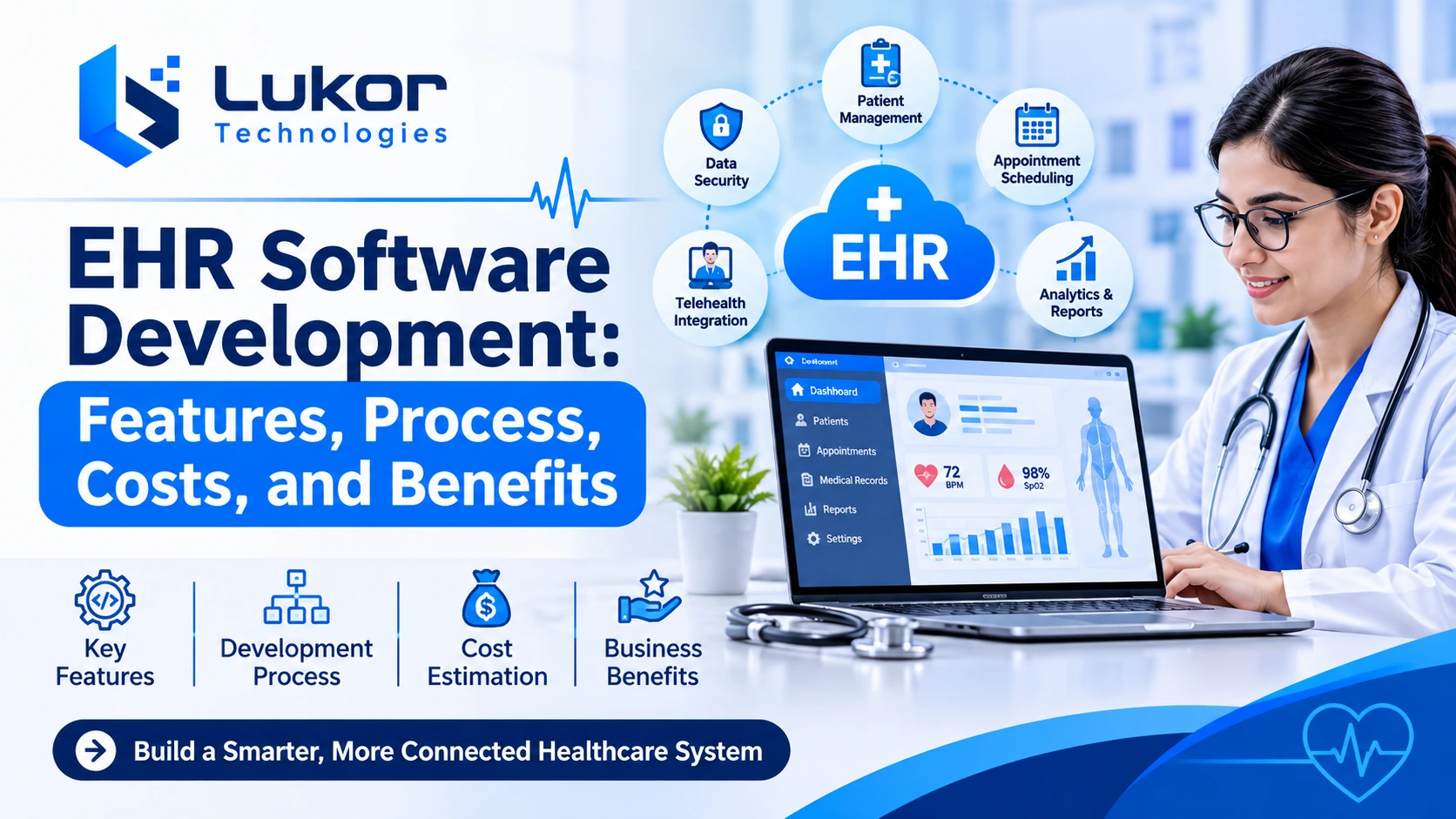
EHR software development is the process of designing, building, and maintaining digital systems that allow healthcare providers to create, store, manage, and exchange patient health information. These systems can include patient records management, appointment scheduling, clinical documentation, e-prescriptions, medical billing, reporting, and healthcare integrations.
In this guide, we explore EHR software features, development processes, technologies, benefits, security requirements, and development costs to help healthcare organizations understand what it takes to build a reliable EHR solution.
What Does EHR Software Development Involve?
EHR software development involves building digital healthcare systems that collect, organize, store, and share patient information across authorized healthcare providers and organizations. Through custom software development, healthcare organizations can create EHR solutions tailored to their clinical workflows, operational needs, and integration requirements.
The process typically includes:
- Requirement analysis and healthcare workflow planning.
- EHR system architecture and UI/UX design.
- Frontend and backend development.
- Patient records and clinical feature implementation.
- Healthcare system and third-party integrations.
- Security and compliance implementation.
- Testing, deployment, and ongoing maintenance.
The objective is to create a secure, scalable system that supports healthcare professionals in managing patient information and delivering coordinated care.
What Is EHR Software Development?
Electronic Health Record (EHR) software is a digital system used to manage comprehensive patient health information throughout their healthcare journey.
Unlike traditional paper records, EHR systems allow authorized healthcare professionals to access and update patient information electronically. Depending on the system, this information may include medical histories, diagnoses, medications, allergies, laboratory results, treatment plans, and clinical notes.
EHR software development focuses on creating these systems to support healthcare workflows, improve information accessibility, and facilitate communication between authorized providers.
For example, when a patient visits a hospital, a healthcare professional can access the patient’s medical history, review previous diagnoses, record new symptoms, and update the treatment plan through an EHR system.
This helps healthcare teams work with more complete patient information instead of relying on disconnected documents and manual records.
How Does an EHR System Work?
An EHR system connects different healthcare activities through a centralized digital platform.
A typical workflow looks like this:
- Patient registration: Staff create a patient profile and record demographic and contact information.
- Medical history collection: Healthcare professionals add previous diagnoses, allergies, medications, and relevant medical history.
- Clinical documentation: Doctors record examination details, diagnoses, treatment plans, and clinical notes.
- Testing and prescriptions: Providers request laboratory tests, review results, and issue electronic prescriptions.
- Information sharing: Authorized users exchange relevant medical information with connected healthcare systems.
- Follow-up and monitoring: Healthcare professionals update patient records and track treatment progress.
The exact workflow depends on the healthcare organization’s requirements and the features included in the EHR solution.
EHR vs. EMR: What Is the Difference?
EHR and EMR are often used interchangeably, but they represent slightly different approaches to digital medical record management.
An Electronic Medical Record (EMR) primarily documents a patient’s medical history within an individual healthcare practice or organization. An Electronic Health Record (EHR) is designed to support a broader view of patient health information and facilitate sharing across authorized healthcare providers.
| Comparison | EHR | EMR |
|---|---|---|
| Full form | Electronic Health Record | Electronic Medical Record |
| Primary purpose | Comprehensive patient health information management | Digital medical records within a practice |
| Information sharing | Designed to support broader information exchange | Often more practice-focused |
| Patient history | Can include information from multiple providers | Primarily maintained within one practice |
| Interoperability | Supports healthcare information exchange | May have more limited exchange capabilities |
| Typical use | Hospitals, healthcare networks, and clinics | Individual medical practices and clinics |
The main difference is the scope of information management and the ability to exchange patient information across healthcare organizations.
Types of EHR Software Systems
Healthcare organizations have different operational requirements, so EHR software is available in several deployment and functionality models.
Understanding these types helps organizations select an appropriate EHR software solution.
1. Physician-Hosted EHR Systems
Physician-hosted EHR systems store and manage medical records using infrastructure maintained by the healthcare organization.
The organization is responsible for managing servers, software updates, security configurations, and system maintenance.
These systems may provide greater control over infrastructure but require dedicated IT resources.
2. Remotely Hosted EHR Systems
Remotely hosted EHR systems store patient information on infrastructure managed by an external hosting provider.
Healthcare organizations access the system through secure network connections without maintaining all the underlying infrastructure themselves.
This approach can reduce internal infrastructure management requirements.
3. Cloud-Based EHR Software
Cloud-based EHR systems operate on cloud infrastructure and allow authorized healthcare professionals to access patient information through supported devices and applications.
Common capabilities include:
- Remote access to patient records.
- Centralized data management.
- Cloud-based backups.
- Flexible infrastructure scaling.
- Integration with external healthcare applications.
Cloud-based systems are particularly useful for healthcare organizations that need flexible access across multiple locations.
4. Specialty-Specific EHR Systems
Specialty-specific EHR systems are designed around the workflows of particular medical specialties.
Examples include:
- Cardiology EHR systems.
- Dermatology EHR systems.
- Oncology EHR systems.
- Dental EHR systems.
- Mental health EHR systems.
- Pediatric EHR systems.
These systems can include specialized clinical templates, documentation fields, and reporting capabilities.
5. Custom EHR Software Solutions
Custom EHR software is developed according to the specific workflows, operational requirements, and integration needs of a healthcare organization.
Instead of adapting every process to an existing product, organizations can develop features that align with their clinical and administrative operations.
Custom EHR development can be useful for healthcare networks, specialty clinics, hospitals, and healthcare technology companies with specific requirements.
Key Features of EHR Software
The features of an EHR system determine how effectively it supports healthcare professionals, administrative teams, and patients. A well-designed EHR platform should simplify clinical documentation, improve access to patient information, and streamline daily healthcare operations.
Here are the essential features to consider when developing an EHR system.
1. Patient Records Management
Patient records management is a core EHR feature that allows healthcare professionals to create, update, and access centralized patient information.
It typically includes:
- Personal and demographic details.
- Medical history and diagnoses.
- Allergies and medications.
- Treatment records and clinical notes.
- Laboratory and diagnostic results.
Centralized records help authorized professionals access relevant patient information during consultations and treatment.
2. Appointment Scheduling and Management
Appointment scheduling helps healthcare organizations manage consultations, follow-up visits, and provider availability.
Key capabilities include:
- Online appointment booking.
- Doctor availability and calendar management.
- Appointment reminders.
- Rescheduling and cancellations.
- Patient check-in management.
These tools help reduce scheduling conflicts and simplify administrative workflows.
3. Clinical Documentation
Clinical documentation enables healthcare professionals to record consultations, examination findings, diagnoses, and treatment plans.
Essential capabilities include:
- Digital clinical notes.
- Diagnosis and medical history records.
- Treatment planning.
- Customizable clinical templates.
- Consultation summaries.
Structured documentation makes patient information easier to review, update, and share with authorized care providers.
4. Electronic Prescriptions (e-Prescribing)
Electronic prescribing allows authorized healthcare professionals to create and transmit prescriptions through supported systems.
Common capabilities include:
- Medication selection and dosage instructions.
- Prescription history and renewals.
- Pharmacy integration.
- Allergy and drug interaction alerts.
Integration with reliable medication databases and prescribing networks helps support safer medication management.
5. Medical Billing and Insurance Management
Billing and insurance features help healthcare organizations manage the financial activities associated with patient care.
Typical capabilities include:
- Patient billing and invoices.
- Insurance information management.
- Claim preparation and tracking.
- Payment records.
- Billing and revenue reports.
The required functionality depends on the organization’s billing workflows and applicable payer requirements.
6. Laboratory and Diagnostic Integration
EHR systems can integrate with laboratory information systems and diagnostic platforms to exchange test requests and results.
Important capabilities include:
- Laboratory test ordering.
- Diagnostic result management.
- Medical imaging integration.
- Report tracking and notifications.
- Patient diagnostic history.
These integrations reduce manual data entry and make diagnostic information easier to access within patient records.
7. Patient Portal and Communication
A patient portal provides secure access to selected health information and communication tools.
Depending on the system, patients can:
- View medical records and test results.
- Request or manage appointments.
- Review prescriptions.
- Receive healthcare notifications.
- Communicate with healthcare providers.
Patient portals improve access to information and encourage greater patient involvement in healthcare.
8. Reporting and Analytics
Reporting and analytics help healthcare organizations monitor clinical activities and operational performance.
Common reporting capabilities include:
- Patient visit and appointment reports.
- Clinical activity summaries.
- Billing and revenue reports.
- Patient demographic insights.
- Operational performance metrics.
Advanced analytics can help identify trends and support informed decisions, subject to appropriate privacy and data governance controls.
9. Role-Based Access Control
Role-based access control (RBAC) ensures that users can access only the patient information and system functions required for their responsibilities.
For example, doctors, nurses, administrators, and billing staff can have different access permissions.
This feature helps protect sensitive health information, support accountability, and strengthen EHR system security.
For example:
| User Role | Typical Access |
|---|---|
| Doctor | Clinical records, diagnoses, treatment plans |
| Nurse | Patient information, clinical notes, medication records |
| Receptionist | Registration and appointment scheduling |
| Billing Staff | Billing and insurance information |
| Administrator | User management and system configuration |
| Patient | Authorized personal health information |
Access permissions should be carefully designed around organizational policies and applicable privacy requirements.
Benefits of Custom EHR Software Development
Custom EHR software development allows healthcare organizations to create digital systems that align with their operational requirements and clinical workflows.
Some of the major benefits include:
1. Improved Patient Care and Clinical Decision-Making
Healthcare professionals need accurate and relevant patient information to make informed clinical decisions. An EHR system brings medical histories, diagnoses, medications, allergies, and test results together in an organized format.
This helps providers review relevant information during consultations and coordinate treatment more effectively.
2. Centralized Patient Information
Traditional record management can involve disconnected documents, spreadsheets, and separate applications. A centralized EHR platform organizes patient information in one system, making it easier for authorized users to retrieve and update records.
This also helps reduce unnecessary duplication of information.
3. Better Healthcare Workflow Efficiency
EHR software can simplify administrative and clinical activities through digital workflows. For example, appointment scheduling, patient registration, clinical documentation, and billing can be managed through connected modules.
This reduces repetitive manual work and helps healthcare teams spend more time on patient-related activities.
4. Reduced Administrative Work
Automated reminders, digital forms, electronic documentation, and integrated billing workflows can reduce administrative tasks. Instead of managing every activity manually, staff can use centralized tools to coordinate routine operations.
5. Improved Data Accuracy and Accessibility
Digital records provide structured ways to enter, organize, and retrieve patient information. Features such as validation rules, standardized fields, and audit trails can help reduce data entry errors and improve record management.
6. Enhanced Patient Engagement
Patient portals and digital communication features make it easier for individuals to access relevant health information. Patients can review selected records, request appointments, and communicate with healthcare providers through supported channels.
7. Scalable Healthcare Operations
Custom EHR platforms can be designed to support changing operational requirements. For example, a healthcare organization may initially build an EHR system for one clinic and later expand it to support multiple locations, additional specialties, and new integrations.
Scalable architecture helps accommodate these changes without requiring a complete system replacement.
EHR Software Development Process: Step by Step
Developing an EHR system requires a structured process that combines healthcare workflow analysis, software engineering, data security, and integration planning.
Each development stage contributes to the reliability and usability of the final platform.
Step 1. Requirement Analysis and Project Planning
The first step is understanding the healthcare organization’s requirements and identifying the problems the EHR system needs to solve. The development team works with relevant stakeholders, including healthcare professionals, administrators, and IT teams.
Key activities include:
- Identifying clinical and administrative workflows.
- Defining the target users.
- Documenting essential features.
- Identifying existing software systems.
- Reviewing data security requirements.
- Establishing project scope and priorities.
For example, a multi-specialty hospital may require patient management, laboratory integration, pharmacy connectivity, and advanced reporting. A small clinic may need a simpler system focused on patient records, appointments, and clinical documentation.
Deliverable: A documented project scope, functional requirements, technical specifications, and development roadmap.
Step 2. EHR System Architecture and Technology Selection
Once requirements are defined, the next step is planning the system architecture. Architecture determines how different components communicate, how patient data is stored, and how the system handles security, performance, and scalability.
Important architectural considerations include:
- Frontend and backend structure.
- Database design.
- API architecture.
- Cloud or on-premises infrastructure.
- Authentication and authorization.
- Data backup and recovery.
- Integration requirements.
Technology selection should depend on project complexity, technical requirements, integration needs, and long-term maintenance.
Deliverable: System architecture, database structure, and technology stack.
Step 3. UI/UX Design and Prototyping
Healthcare professionals often work with complex information under time constraints. Therefore, an EHR interface should be intuitive and easy to navigate. The design team creates wireframes and prototypes to demonstrate how users will interact with the system.
Important design considerations include:
- Simple navigation.
- Readable patient information.
- Clear clinical dashboards.
- Easy-to-use data entry forms.
- Responsive layouts.
- Accessible interface elements.
For example, a doctor’s dashboard should make patient histories, consultation notes, diagnoses, and treatment information easy to locate.
Deliverable: Wireframes, interactive prototypes, and approved interface designs.
Step 4. Frontend and Backend Development
This stage involves building the core EHR application. Frontend development focuses on the user interface, while backend development handles business logic, data processing, authentication, and communication between system components.
Frontend development may include:
- Patient dashboards.
- Appointment interfaces.
- Clinical documentation screens.
- Administrative panels.
- Patient portals.
Backend development may include:
- Patient record management.
- User authentication.
- Data processing.
- Appointment workflows.
- Prescription management.
- Reporting functionality.
- API development.
The system should be developed using modular architecture where appropriate, making individual components easier to maintain and improve.
Deliverable: Functional frontend and backend modules.
Step 5. EHR Software Integration
Healthcare organizations often use multiple applications to manage clinical and administrative activities.
An EHR system may need to integrate with:
- Laboratory information systems.
- Pharmacy platforms.
- Medical billing applications.
- Medical imaging systems.
- Insurance and claims platforms.
- Hospital information systems.
- Patient communication applications.
Integration requirements should be identified early to avoid compatibility problems later in development.
Deliverable: Tested APIs, integration workflows, and data exchange functionality.
Step 6. Security and Compliance Implementation
Patient health information requires appropriate privacy and security protections. Security should be considered throughout the development lifecycle rather than added only before deployment.
Important activities include:
- Implementing authentication and access controls.
- Encrypting sensitive information where appropriate.
- Configuring audit logging.
- Reviewing application vulnerabilities.
- Establishing backup and recovery procedures.
- Conducting security risk assessments.
- Documenting security policies and procedures.
The development team should work with the healthcare organization to understand applicable regulatory requirements.
Deliverable: Implemented security controls, risk documentation, and compliance-related technical documentation.
Step 7. Testing and Quality Assurance
Quality assurance ensures that the EHR system performs reliably and supports intended healthcare workflows. The testing process should cover technical functionality, data accuracy, security, system performance, and practical usability.
Important testing activities include:
- Functional testing.
- Integration testing.
- Performance testing.
- Security testing.
- User acceptance testing.
- Data migration validation.
- Backup and recovery testing.
Healthcare professionals should participate in user acceptance testing because they understand the practical requirements of clinical workflows.
Deliverable: Tested application, documented defects, and release approval.
Step 8. Deployment and Ongoing Maintenance
After successful testing, the EHR platform can be deployed to the selected infrastructure.
Deployment activities include:
- Production environment configuration.
- Data migration.
- User account setup.
- System configuration.
- Staff training.
- Deployment monitoring.
- Backup verification.
Development does not end after launch. EHR systems require regular maintenance, security updates, performance monitoring, and improvements as healthcare requirements change.
Deliverable: Deployed EHR system, user documentation, and ongoing maintenance plan.
EHR Software Development Process at a Glance
| Development Stage | Main Purpose | Expected Deliverable |
|---|---|---|
| Requirement analysis | Understand healthcare workflows | Project requirements |
| Architecture planning | Design system structure | Technical architecture |
| UI/UX design | Create user-friendly interfaces | Wireframes and prototypes |
| Development | Build core functionality | Working EHR modules |
| Integration | Connect external systems | Integrated applications |
| Security implementation | Protect patient information | Security controls |
| Testing | Validate reliability and functionality | Tested application |
| Deployment | Launch the platform | Production-ready system |
Technologies Used in EHR Software Development
The technology stack determines how an EHR system is built, deployed, maintained, and integrated with other healthcare applications.
The right technologies depend on the application’s complexity, expected user volume, infrastructure requirements, and integration needs.
Here are the main technology categories used in EHR system development.
Frontend Technologies
Frontend technologies are used to build the interfaces that healthcare professionals and patients interact with.
Common options include:
- React
- Angular
- Vue.js
- HTML
- CSS
- JavaScript
These technologies can support dashboards, patient portals, clinical documentation interfaces, and administrative applications.
Backend Technologies
Backend technologies manage business logic, application workflows, APIs, authentication, and data processing.
Common options include:
- Node.js
- Python
- Java
- .NET
- PHP
The selection depends on performance requirements, existing infrastructure, development expertise, and integration needs.
Databases and Cloud Infrastructure
EHR systems need reliable data storage and infrastructure to manage patient information.
Common database technologies include:
- PostgreSQL
- MySQL
- Microsoft SQL Server
- MongoDB
Cloud infrastructure may use services from:
- Amazon Web Services (AWS)
- Microsoft Azure
- Google Cloud
Healthcare organizations should evaluate hosting providers, security configurations, contractual requirements, and responsibilities for protecting electronic protected health information before selecting an infrastructure provider.
DevOps practices also help development teams automate testing, manage deployments, and maintain reliable software environments. Learn more about how DevOps practices support software development and delivery.
AI and Machine Learning
Artificial intelligence can support selected EHR workflows when implemented with appropriate clinical oversight.
Potential applications include:
- Clinical documentation assistance.
- Medical record summarization.
- Data classification.
- Administrative workflow automation.
- Predictive analytics.
- Clinical decision support.
AI-generated information should be reviewed by qualified healthcare professionals where clinical decisions are involved. Organizations should also consider privacy, accuracy, bias, transparency, and validation requirements.
EHR Software Integration and Interoperability
Interoperability is an important consideration in EHR software development because patient information often needs to move between different healthcare applications and organizations.
Healthcare interoperability standards help different healthcare applications exchange information in consistent formats. Organizations can refer to healthcare interoperability standards to understand the frameworks and technologies supporting health information exchange.
Without appropriate integration, healthcare professionals may need to enter the same information into multiple systems, increasing administrative work and the risk of inconsistencies.
Healthcare interoperability standards help systems exchange information in structured and understandable formats.
HL7 Integration
Health Level Seven (HL7) develops standards that support the exchange of healthcare information between different systems.
HL7 messaging standards are commonly used for exchanging information such as:
- Patient admission and registration.
- Laboratory orders and results.
- Clinical observations.
- Patient transfers.
- Healthcare administrative information.
HL7 integration can help connect EHR platforms with hospital information systems, laboratory applications, and other healthcare technologies.
FHIR Integration
Fast Healthcare Interoperability Resources (FHIR) is a healthcare data exchange standard developed by HL7.
It uses structured resources to represent information such as patients, practitioners, medications, observations, and diagnostic reports.
FHIR can support API-based healthcare data exchange and integration between modern healthcare applications.
For example, an EHR system may use FHIR-based APIs to retrieve patient information from another authorized healthcare application.
For technical implementation details, developers can refer to the official HL7 FHIR standard, which defines resources and APIs for exchanging healthcare information between compatible systems.
Laboratory Information Systems (LIS)
Integration with a Laboratory Information System allows EHR platforms to exchange laboratory orders and results.
This can help healthcare professionals access diagnostic information without manually transferring reports between separate applications.
Pharmacy and e-Prescribing Integration
Pharmacy integration supports the electronic exchange of prescription-related information.
Depending on the connected systems and applicable standards, it can support prescription transmission, medication information, and pharmacy communication.
Medical Imaging and PACS Integration
Picture Archiving and Communication Systems (PACS) are used to store, retrieve, and manage medical imaging information.
Integrating an EHR system with PACS can help healthcare professionals access relevant imaging studies and reports alongside patient records.
Healthcare APIs and Third-Party Integrations
APIs allow EHR platforms to communicate with external applications and services.
Examples include:
- Billing applications.
- Insurance systems.
- Telehealth platforms.
- Patient communication tools.
- Healthcare analytics platforms.
Integration with telemedicine app development solutions can also help connect virtual consultations with EHR systems, allowing authorized healthcare professionals to access relevant patient records during remote appointments.
The integration approach should account for data formats, authentication, permissions, error handling, and data consistency.
HIPAA Compliance and EHR Software Security
Security and privacy are fundamental considerations when developing EHR software, particularly when the system stores or transmits electronic protected health information (ePHI).
For healthcare organizations operating in the United States, the Health Insurance Portability and Accountability Act (HIPAA) establishes requirements for protecting applicable health information.
The HIPAA Security Rule requires regulated entities to implement appropriate administrative, physical, and technical safeguards to protect the confidentiality, integrity, and availability of ePHI.
Importantly, building an EHR application with security features does not automatically make an organization or product HIPAA compliant. Compliance involves organizational policies, risk management, workforce practices, business associate arrangements where applicable, and technical safeguards.
Healthcare organizations handling electronic protected health information should understand the applicable HIPAA privacy and security requirements when planning and developing EHR platforms.
1. Data Encryption
Encryption helps protect sensitive information from unauthorized access.
Organizations should evaluate encryption for data stored in databases, backups, and information transmitted between applications.
2. Role-Based Access Control
Access permissions should be assigned according to job responsibilities.
For example, doctors, nurses, receptionists, billing teams, and administrators may require different levels of access to patient information.
3. Authentication and Authorization
Authentication verifies a user’s identity, while authorization determines what that user can access.
Security measures may include:
- Multi-factor authentication.
- Secure login processes.
- Session management.
- Permission-based access.
- Account monitoring.
4. Audit Logs and Activity Monitoring
Audit logs record important activities performed within the system.
These may include:
- Patient record access.
- Information updates.
- User login activity.
- Changes to clinical documentation.
- Administrative actions.
Audit trails help organizations review system activity and investigate potential security incidents.
5. Data Backup and Disaster Recovery
Healthcare organizations need appropriate backup and recovery processes to maintain access to critical information.
A reliable strategy should include:
- Regular data backups.
- Secure backup storage.
- Recovery testing.
- Business continuity planning.
- Disaster recovery procedures.
6. HIPAA Risk Assessment and Security Management
A risk assessment helps identify potential vulnerabilities and threats affecting electronic protected health information.
Organizations should regularly review security controls, assess risks, document procedures, and update safeguards when necessary.
The official HHS HIPAA Security Rule guidance provides further information about these requirements.
How Much Does EHR Software Development Cost?
The cost of EHR software development depends on the application’s complexity, number of features, integration requirements, security needs, technology stack, and development team.
A basic EHR platform with patient records and appointment management requires fewer resources than an enterprise healthcare system supporting multiple facilities, complex integrations, and advanced reporting.
For initial planning, the following ranges can be used as illustrative estimates for custom development projects.
Estimated EHR Software Development Cost
| EHR Software Type | Estimated Development Cost | Typical Scope |
|---|---|---|
| Basic EHR System | $30,000–$60,000 | Patient records, appointments, basic documentation |
| Mid-Level EHR System | $60,000–$150,000 | Clinical workflows, billing, reporting, integrations |
| Advanced EHR Platform | $150,000–$300,000+ | Advanced modules, multiple integrations, complex workflows |
| Enterprise EHR System | $300,000+ | Multi-location operations, advanced interoperability, extensive customization |
The overall investment depends on project complexity, required integrations, security requirements, and development time. For a broader understanding of pricing factors, read our guide to custom software development costs.
Factors That Affect EHR Software Development Costs
Several factors influence the overall cost of building an EHR system.
1. Software Complexity and Features
A basic system with patient registration and appointment scheduling requires less development effort than a platform with advanced clinical documentation, billing, analytics, patient portals, and multiple user roles.
2. UI/UX Design Requirements
The number of user interfaces, dashboards, workflows, and device requirements affects design and development effort.
Complex clinical workflows may require additional prototyping and usability testing.
3. Third-Party Integrations
Integrating laboratory systems, pharmacies, medical imaging applications, insurance platforms, and external healthcare networks can increase development costs.
Integration complexity depends on available APIs, data standards, vendor requirements, and testing needs.
4. Security and Compliance Requirements
Security architecture, access controls, encryption, audit logging, risk assessments, and documentation require dedicated development and review effort.
5. Development Team and Technology Stack
The cost also depends on team size, technical expertise, development location, project duration, and the technologies selected.
6. Testing, Deployment, and Maintenance
Functional testing, security testing, data migration, deployment, staff training, and ongoing maintenance should be included in the project budget.
A realistic budget should consider both initial development and long-term operating expenses.
How Long Does It Take to Develop EHR Software?
EHR software development timelines depend on the number of features, integration complexity, data migration requirements, security reviews, and stakeholder availability.
A smaller EHR application may take a few months, while a complex enterprise platform can require a year or longer.
The following estimates provide a general planning reference.
| Project Type | Estimated Timeline |
|---|---|
| Basic EHR System | 3–5 months |
| Mid-Level EHR System | 5–9 months |
| Advanced EHR Platform | 9–12 months |
| Enterprise EHR System | 12–18+ months |
These timelines are indicative rather than guaranteed delivery schedules.
What Affects the Development Timeline?
- Number and complexity of features.
- Healthcare system integration requirements.
- Data migration from legacy applications.
- Security and compliance reviews.
- Testing and user acceptance.
- Stakeholder feedback and approval.
- Deployment and staff training.
Defining project requirements early and prioritizing essential functionality can help healthcare organizations manage development timelines more effectively.
Common Challenges in EHR Software Development
Although EHR systems offer important operational benefits, developing and implementing them involves several technical and organizational challenges.
Understanding these challenges early helps organizations plan more effectively.
1. Healthcare Data Security Risks
EHR platforms handle sensitive patient information, making them potential targets for unauthorized access, data breaches, and other security incidents.
Developers must consider secure architecture, access controls, encryption, audit logging, vulnerability testing, and ongoing security management.
2. System Interoperability Issues
Healthcare organizations often use applications from different vendors, each with its own data structures and integration requirements. Without proper interoperability planning, information exchange can become difficult.
Using appropriate standards such as HL7 and FHIR can help address these challenges.
3. Legacy System Integration
Hospitals and clinics may already use older healthcare applications that cannot easily communicate with modern EHR platforms. Integration may require custom APIs, data transformation, middleware, or carefully planned migration processes.
4. Regulatory Compliance
Healthcare software must be designed around applicable privacy, security, and healthcare regulations. Organizations operating in the United States need to evaluate HIPAA requirements and any other applicable federal or state obligations.
Compliance responsibilities should be addressed throughout planning, development, deployment, and ongoing operations.
5. Data Migration and Accuracy
Moving information from paper records or existing applications into a new EHR system can be complicated. Potential issues include duplicate records, incomplete information, inconsistent formats, and data mapping errors.
Organizations should establish validation procedures and carefully review migrated information before production use.
6. User Adoption and System Usability
Even a technically advanced EHR platform can create problems if healthcare professionals find it difficult to use. Complex interfaces and unnecessary documentation steps may disrupt existing workflows.
Involving doctors, nurses, and administrative staff during design and testing helps identify usability problems before deployment.
7. Scalability and Performance
As healthcare organizations grow, EHR platforms may need to support additional users, facilities, records, and integrations. A scalable architecture helps maintain system performance as operational requirements change.
Many of these issues also affect software projects across industries, including integration complexity, security risks, scalability, and changing technical requirements. Explore these common software development challenges to understand how development teams address them.
How to Choose the Right EHR Software Development Company
Selecting the right EHR software development company is an important decision because healthcare applications involve complex workflows, sensitive information, and integration requirements.
Beyond technical expertise, organizations should evaluate communication, development processes, security practices, and long-term support when choosing the right software development partner.
Before choosing a development partner, evaluate the following factors.
1. Healthcare Industry Experience
AI-powered tools can assist with summarizing clinical notes, organizing information, and reducing repetitive documentation activities.
For example, AI-assisted documentation tools may help prepare consultation summaries for healthcare professionals to review.
Healthcare organizations can explore AI development solutions to build intelligent applications that support clinical documentation, workflow automation, and healthcare data analysis.
However, clinical information must be validated, and appropriate privacy and governance controls are essential.
2. Technical Expertise and Technology Stack
Evaluate the company’s experience with front-end and back-end development, databases, cloud infrastructure, APIs, and scalable software architecture. The technology stack should match the project’s technical and operational requirements.
3. HIPAA and Security Knowledge
The development partner should understand healthcare data protection requirements and be able to implement appropriate technical security controls. Ask how the team approaches authentication, access management, encryption, audit logging, security testing, and documentation.
4. Integration and Interoperability Capabilities
Healthcare systems often need to exchange information with external applications. Check whether the development team has experience with HL7, FHIR, healthcare APIs, laboratory systems, pharmacy platforms, and medical imaging integrations.
5. Development Methodology
A structured development process helps manage requirements, technical decisions, testing, and project delivery. Look for clear communication, documentation, regular progress reviews, and defined testing procedures.
6. Portfolio and Case Studies
Review previous healthcare projects to understand the company’s technical capabilities and experience. Look for examples that demonstrate real implementation challenges, integrations, application features, and business requirements.
7. Post-Launch Support and Maintenance
EHR software requires ongoing maintenance after deployment. Discuss the availability of technical support, bug fixes, security updates, performance monitoring, and future feature improvements.
Choosing a development partner should involve evaluating both technical capabilities and its understanding of healthcare operations.
Future Trends in EHR Software Development
Healthcare technology continues to evolve, and EHR systems are becoming more connected, intelligent, and focused on improving clinical and administrative workflows.
Several emerging technologies are influencing the future of EHR software development.
1. AI-Powered Clinical Documentation
AI-powered tools can assist with summarizing clinical notes, organizing information, and reducing repetitive documentation activities.
For example, AI-assisted documentation tools may help prepare consultation summaries for healthcare professionals to review.
However, clinical information must be validated, and appropriate privacy and governance controls are essential.
2. Predictive Analytics in Healthcare
Predictive analytics can help healthcare organizations identify patterns in historical and operational data.
Potential applications include patient risk analysis, resource planning, population health management, and operational forecasting.
These applications require appropriate data quality, validation, and clinical oversight.
3. Cloud-Based EHR Platforms
Cloud technology provides flexible infrastructure for managing healthcare applications and supporting access across multiple locations.
Cloud-based EHR platforms can simplify infrastructure scaling, centralized management, and integration with other digital healthcare services.
4. Telehealth and Remote Patient Monitoring Integration
The growing use of digital healthcare services creates opportunities to connect EHR systems with telehealth and remote patient monitoring applications.
Such integrations can help healthcare professionals access relevant consultation information, monitoring data, and patient records through connected systems.
5. Automation of Clinical Workflows
Workflow automation can simplify administrative tasks such as appointment reminders, documentation routing, record updates, and selected billing activities.
Automation should be designed with appropriate approval processes, auditability, and human oversight.
6. Patient-Centered Digital Health Systems
Future EHR platforms are likely to place greater emphasis on patient access, communication, and information sharing.
Patient portals, mobile healthcare applications, and connected digital services can help individuals interact with healthcare providers more conveniently.
Conclusion
EHR software development plays an important role in helping healthcare organizations modernize patient information management, improve clinical workflows, and support better coordination between healthcare professionals.
Building an effective EHR platform requires careful planning, essential clinical features, scalable architecture, secure data management, and reliable interoperability. Healthcare organizations must also consider development costs, implementation timelines, user adoption, and ongoing maintenance.
The right approach depends on the organization’s size, healthcare specialty, existing infrastructure, and long-term digital transformation goals. Whether developing a basic patient records system or a comprehensive enterprise EHR platform, prioritizing usability, security, and interoperability can help create a solution that supports evolving healthcare needs.
Lukor Technologies is a custom software development company helping businesses build digital solutions tailored to their operational requirements. With experience in healthcare software development, web and mobile applications, and custom software engineering, the team can help organizations plan and develop scalable healthcare technology solutions.
If you are planning to build or modernize an EHR platform, contact Lukor Technologies to discuss your software development requirements.
Frequently Asked Questions
1. What is EHR software development?
EHR software development is the process of designing, building, and maintaining digital systems that manage electronic patient health records. These systems can include patient information management, clinical documentation, appointment scheduling, prescriptions, billing, and healthcare integrations.
2. How much does it cost to develop EHR software?
EHR software development can cost approximately $30,000 to $60,000 for a basic system, $60,000 to $150,000 for a mid-level platform, and $150,000 to $300,000 or more for advanced solutions. Enterprise systems may require larger budgets depending on features, integrations, security requirements, and project complexity.
3. How long does it take to build an EHR system?
A basic EHR system may take around 3–5 months to develop, while a mid-level platform may require 5–9 months. Advanced and enterprise EHR systems can take 9–18 months or longer, depending on functionality, integrations, testing, and deployment requirements.
4. What are the essential features of EHR software?
Essential EHR software features include patient records management, appointment scheduling, clinical documentation, electronic prescriptions, medical billing, laboratory integration, patient portals, reporting, and role-based access control.
5. What technologies are used in EHR software development?
Common technologies include React, Angular, Node.js, Python, Java, .NET, PostgreSQL, MySQL, AWS, and Microsoft Azure. Healthcare interoperability standards such as HL7 and FHIR are also important for exchanging information between connected healthcare systems.
6. Is custom EHR software required to be HIPAA compliant?
When a custom EHR system is used by a HIPAA-regulated covered entity or business associate to create, receive, maintain, or transmit electronic protected health information, applicable HIPAA requirements must be addressed. Compliance is not achieved through software features alone; it also involves organizational policies, risk assessments, appropriate safeguards, and operational practices.
7. What is the difference between EHR and EMR software?
EMR software primarily manages digital medical records within an individual medical practice or organization. EHR software is designed to provide a broader view of patient health information and support information exchange across authorized healthcare providers and organizations.