
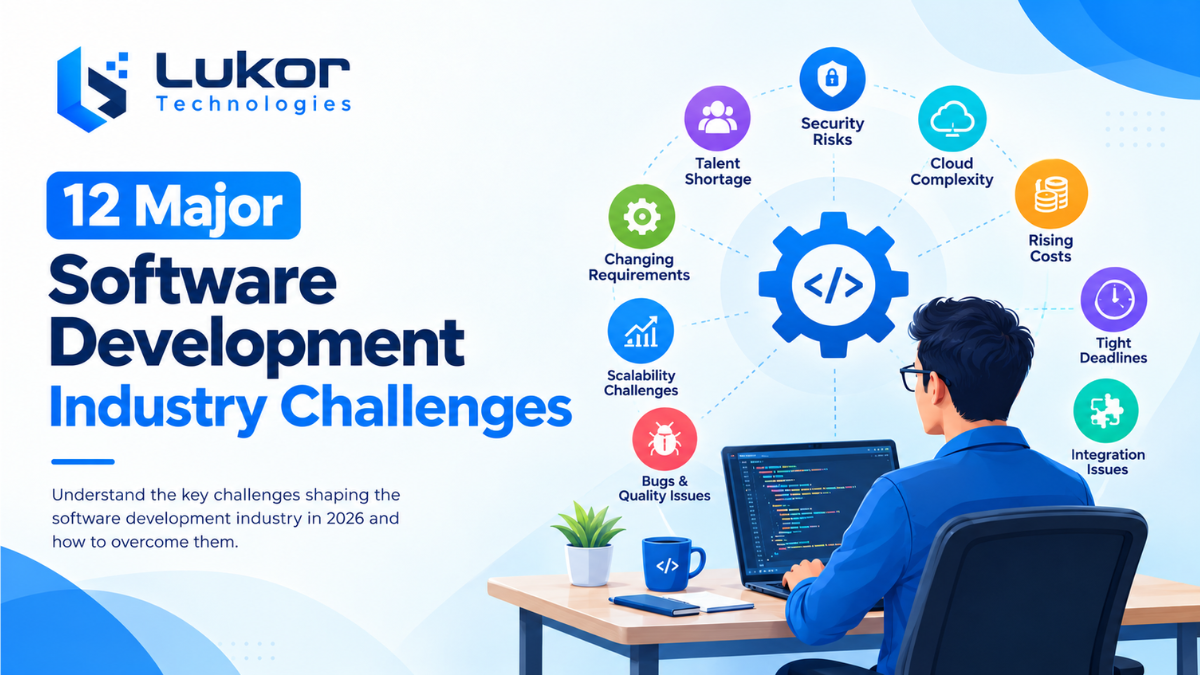
Software development is becoming more complex as businesses increasingly rely on digital products, cloud platforms, artificial intelligence (AI), APIs, automation, and interconnected systems. At the same time, development teams are expected to deliver software faster while maintaining quality, security, scalability, and cost control.
These changes have created several software development industry challenges that affect businesses, development teams, and technology leaders. AI is adding another layer to this complexity. According to Stack Overflow’s Survey, 84% of developers were using or planning to use AI tools, while 46% said they did not trust the accuracy of AI output.
The most common challenges include rising development costs, skill shortages, changing requirements, cybersecurity risks, technical debt, AI adoption, software testing, system integration, scalability, communication, and rapidly changing technologies.
Understanding these challenges can help businesses plan software projects more realistically, manage development risks, and make better technology decisions.
Quick Answer: What Are the Biggest Software Development Industry Challenges in 2026?
The biggest software development industry challenges in 2026 include rising development costs, shortages of skilled developers, changing requirements, project delays, cybersecurity and data privacy risks, technical debt, AI-generated code risks, software testing difficulties, integration problems, scalability issues, communication gaps, and rapidly changing technologies.
AI is also changing how software is developed. A 2026 JetBrains survey of more than 15,000 professional developers found that 90% were using AI coding agents at work at least weekly, with 68% using them daily. This makes AI adoption an important part of the industry’s current development and security challenges.
Why Is the Software Development Industry Becoming More Challenging?
Software development has become more complex as businesses rely on applications to support critical operations, customer experiences, and digital services. Modern software rarely works as an isolated system. It often needs to connect with cloud infrastructure, databases, third-party APIs, payment platforms, analytics tools, AI services, mobile devices, and existing business systems.
At the same time, users expect faster performance, reliable experiences, regular updates, and stronger security. Businesses must also manage growing amounts of data while meeting changing privacy and security requirements.
Artificial intelligence is adding another layer to this environment. AI coding tools can help developers generate code, analyze existing systems, create tests, and automate development tasks. However, their use also requires careful code review, testing, security controls, and human oversight.
These factors make modern software development a balance between speed, cost, quality, security, scalability, and long-term maintainability. Understanding these challenges is essential for planning and managing successful software projects.
12 Major Software Development Industry Challenges in 2026
1. Rising Software Development Costs
Cost remains one of the most common software development challenges for businesses.
Software projects can become more expensive when requirements change, integrations become more complex, additional testing is required, or the original scope was underestimated.
Development costs may also increase because of:
- Complex application requirements
- Multiple platforms and devices
- Third-party integrations
- Cloud infrastructure
- Security requirements
- Advanced testing
- AI and machine learning functionality
- Post-launch maintenance
Businesses should consider the complete project lifecycle rather than looking only at the initial development price. Maintenance, infrastructure, security updates, performance improvements, and future feature development can all contribute to the total cost.
For a detailed explanation of the factors that influence project pricing, see Software Development Cost.
The best way to control costs is to define the core requirements early, prioritize features, identify technical dependencies, and establish realistic project milestones.
2. Shortage of Skilled Software Developers
Finding developers with the right technical and domain expertise can be difficult, particularly for projects involving specialized technologies.
Modern development teams may need knowledge across areas such as:
- Cloud computing
- Artificial intelligence
- Cybersecurity
- DevOps
- Data engineering
- Mobile development
- Web application development
- System architecture
The challenge is not simply finding people who can write code. Businesses often need professionals who understand architecture, security, testing, scalability, and the business problem the software is intended to solve.
Skill gaps can increase development time and make it harder to maintain consistent software quality.
Organizations can address this challenge through continuous training, better technical documentation, knowledge sharing, and carefully structured development teams.
3. Changing Requirements and Scope Creep
Changing requirements are another major cause of software development problems.
Business priorities can change during development. New customer requirements may appear, stakeholders may request additional features, or technical limitations may become clear only after implementation begins.
When these changes are not properly managed, scope creep can result.
Scope creep can lead to:
- Higher development costs
- Longer delivery timelines
- Increased technical complexity
- More testing requirements
- Rework
- Conflicts between stakeholders and development teams
A clear requirements process can reduce these problems. Teams should define the project’s objectives, prioritize features, document changes, and evaluate the effect of major changes before adding them to the development scope.
For businesses considering a solution built around their specific workflows, understanding what custom software development is can also help clarify how requirements influence the design and development process.
4. Project Delays and Inaccurate Estimates
Software development projects can be difficult to estimate because technical complexity is not always visible at the beginning.
A feature that appears simple may require extensive backend development, database changes, third-party integrations, security work, or testing.
Common causes of software project delays include:
- Unclear requirements
- Unrealistic deadlines
- Dependency problems
- Changing project scope
- Integration difficulties
- Limited testing time
- Poor communication
- Underestimated technical complexity
More reliable estimation starts with breaking the project into smaller deliverables and identifying dependencies early.
Instead of estimating the entire project as one large task, teams can use milestones and smaller development cycles to improve visibility and adjust plans as new information becomes available.
5. Cybersecurity and Data Privacy Risks
Cybersecurity has become a fundamental part of modern software development.
Applications may process customer information, financial data, authentication credentials, business information, and other sensitive data. A vulnerability in the application or one of its dependencies can create significant security risks.
Common security concerns include:
- Broken authentication
- Improper access control
- Insecure APIs
- Vulnerable dependencies
- Poor input validation
- Exposed credentials
- Inadequate encryption
- Software supply-chain risks
AI-assisted development introduces additional security considerations. OWASP’s 2026 guidance highlights risks such as hallucinated dependencies, indirect prompt injection, insecure AI tool access, and exposure of sensitive code or project context.
Security should therefore be considered throughout the development lifecycle rather than treated as a final testing step.
6. Technical Debt and Legacy Systems
Technical debt occurs when development teams choose a quick or temporary implementation that creates additional work or limitations later.
Technical debt can accumulate when:
- Code is poorly documented
- Older dependencies remain in use
- Testing is limited
- Architecture is not updated as requirements change
- Temporary solutions become permanent
- New features are repeatedly added to outdated systems
Legacy systems create a related challenge. Older applications may still support important business processes but can be difficult to maintain, integrate, or scale.
Businesses do not always need to replace legacy systems completely. In many cases, modernization can be approached incrementally through API integration, modularization, database modernization, infrastructure upgrades, or gradual replacement of specific components.
7. AI Adoption and AI-Generated Code Risks
AI is one of the biggest changes affecting software development in 2026.
AI coding assistants and coding agents can generate code, explain existing code, create tests, troubleshoot issues, and automate parts of the development workflow. According to JetBrains’ 2026 research, 90% of surveyed professional developers were using AI coding agents at work at least weekly.
However, increased AI adoption also creates new AI challenges in software development.
These include:
- Incorrect or hallucinated code
- Security vulnerabilities
- Unverified dependencies
- Poorly understood generated code
- Inconsistent coding patterns
- Sensitive information exposure
- Overreliance on AI-generated tests
- Difficulty determining responsibility for AI-generated changes
OWASP specifically recommends verifying AI-suggested dependencies and applying additional review to AI-generated changes involving build scripts, CI/CD configurations, deployment files, and other security-sensitive components.
The practical approach is not to avoid AI, but to use it with appropriate human review, automated testing, security checks, access controls, and clear development policies.
8. Software Testing and Quality Assurance
As applications become more complex, testing becomes more difficult.
A modern application may need to work across different browsers, operating systems, devices, databases, APIs, cloud environments, and third-party services.
Common software testing challenges include:
- Large numbers of test cases
- Regression testing
- Integration testing
- Performance testing
- Security testing
- Mobile and browser compatibility
- Testing third-party integrations
- Maintaining reliable automated tests
Testing should begin early rather than being left until the end of development.
Automated testing can help teams repeatedly verify important functionality, while manual testing remains useful for areas that require human judgment, usability evaluation, and exploratory testing.
AI-generated tests should also be reviewed rather than treated as automatically correct. Passing tests do not necessarily prove that the application behaves securely or correctly. OWASP’s 2026 secure coding guidance specifically warns against treating AI-generated test suites as sufficient evidence of security.
9. Integration and Interoperability Challenges
Businesses rarely operate with a single software system.
A typical technology environment may include:
- Customer relationship management systems
- Enterprise resource planning systems
- Payment platforms
- Accounting software
- Inventory systems
- Communication tools
- Analytics platforms
- Cloud services
- Internal databases
Connecting these systems can create significant software integration challenges.
Problems may occur because systems use different data formats, authentication methods, APIs, business rules, or update schedules.
Poorly planned integrations can result in duplicated data, synchronization problems, failed transactions, and unreliable workflows.
Before development begins, teams should identify the systems involved, understand available APIs and integration methods, define data ownership, and establish how errors and failures will be handled.
10. Scalability and Performance Issues
Software that works well with a small number of users may not perform the same way when usage increases.
Scalability challenges can involve:
- Database performance
- Server capacity
- API response times
- Large data volumes
- Concurrent users
- Network limitations
- Cloud infrastructure
- Poorly optimized application logic
Scalability should be considered during architecture and development rather than after performance problems appear.
This does not mean every application needs a highly complex architecture from day one. Instead, the architecture should match current requirements while allowing practical paths for future growth.
Performance testing, monitoring, caching, database optimization, and appropriate infrastructure planning can help identify bottlenecks before they become major problems.
11. Communication and Collaboration Gaps
Software development involves multiple groups, including business stakeholders, product managers, designers, developers, testers, security teams, and operations teams.
When these groups have different expectations, communication problems can quickly affect the project.
Common issues include:
- Unclear responsibilities
- Incomplete requirements
- Poor documentation
- Delayed feedback
- Misunderstood priorities
- Communication across time zones
- Limited visibility into project progress
Strong communication does not require more meetings. It requires clear ownership, accessible documentation, regular feedback, defined priorities, and a shared understanding of project objectives.
Teams should also make technical decisions visible to relevant stakeholders so that important trade-offs are understood before they create problems later.
12. Keeping Up With Rapidly Changing Technologies
Technology changes quickly.
New frameworks, cloud services, AI models, development tools, security practices, and platforms appear regularly. Choosing the wrong technology can create long-term maintenance problems, while constantly changing technologies can also distract teams from delivering the actual product.
The challenge is therefore not simply keeping up with every new technology.
Teams need to determine:
- Which technologies solve a real business problem
- Whether the technology is mature enough
- How well it integrates with existing systems
- Whether skilled developers are available
- How difficult it will be to maintain
- What the long-term costs may be
- Whether the technology supports future requirements
Technology decisions should be based on project requirements rather than trends alone.
How Can Businesses Overcome Software Development Challenges?
There is no single solution to every software development problem. However, businesses can reduce many common risks by improving how projects are planned, developed, tested, and maintained.
1. Define Requirements Clearly
Start by identifying the business problem, target users, core functionality, technical requirements, and expected outcomes. Clear requirements help reduce rework, improve estimates, and give development teams a defined direction.
2. Prioritize Features
Not every feature needs to be developed at once. Prioritize features based on business value, user needs, technical dependencies, and available resources. This allows teams to focus on the functionality that matters most.
3. Set Realistic Budgets and Timelines
Software projects can become more expensive or take longer when complexity is underestimated. Budgets and timelines should account for development, testing, integrations, security, deployment, maintenance, and potential requirement changes.
4. Build Security Into the Development Lifecycle
Security should be considered from the beginning rather than added after development is complete. Use appropriate access controls, secure coding practices, dependency management, vulnerability testing, and security reviews throughout the development lifecycle.
5. Manage Technical Debt
Technical debt should be identified and addressed before it significantly affects development speed or software quality. Regular refactoring, dependency updates, automated testing, documentation, and architecture reviews can help keep the codebase maintainable.
6. Use AI With Appropriate Oversight
AI coding tools can accelerate development, but AI-generated code still requires human review and testing. Teams should establish clear guidelines for AI tool usage, sensitive data, dependencies, security-sensitive code, and approval processes.
7. Plan for Scalability
Consider expected users, data volumes, integrations, performance requirements, and future growth during architecture planning. The goal is not to over-engineer the application, but to create a practical foundation that can support increasing demand.
8. Improve Team Communication
Clear documentation, defined responsibilities, regular reviews, and transparent project tracking can reduce communication gaps. Teams should also have a clear process for documenting and evaluating changes to project requirements.
9. Choose Technology Based on Requirements
The newest technology is not always the right technology. Technology decisions should consider performance, security, scalability, maintainability, integration requirements, available expertise, and long-term project goals.
10. Choose the Right Development Partner
When working with an external team, businesses should evaluate more than development costs when selecting a Custom Software Development Company.
Important factors include:
- Relevant technical experience
- Similar project experience
- Development and testing practices
- Security processes
- Communication and collaboration
- Scalability expertise
- Post-launch support
The right development partner should understand both the technical requirements and the business objectives behind the software. This can help reduce development risks and create a stronger foundation for long-term software maintenance and growth.
Future of Software Development: Challenges to Watch
The future of software development will be shaped by artificial intelligence, cloud computing, automation, and increasingly connected systems. These technologies can improve how software is built and maintained, but they also introduce new technical, security, and operational challenges.
Some of the key challenges businesses and development teams will need to manage include:
- AI-generated and AI-assisted code: Ensuring AI-generated code is accurate, secure, maintainable, and properly reviewed.
- AI security and governance: Protecting source code, business data, credentials, and development environments when using AI tools.
- Increasing software complexity: Managing applications that depend on multiple services, APIs, cloud platforms, and external systems.
- Legacy system modernization: Updating older applications without disrupting critical business operations.
- Cloud and infrastructure costs: Managing infrastructure efficiently as applications, users, and data volumes grow.
- Changing technical skills: Continuously developing expertise in AI, cloud computing, cybersecurity, automation, and emerging technologies.
- Software supply-chain security: Managing vulnerabilities across open-source packages, third-party services, dependencies, and development tools.
- Balancing speed with quality: Delivering software faster without compromising reliability, security, testing, or maintainability.
- Human oversight of automation: Maintaining appropriate human involvement in important technical and business decisions.
As AI-assisted development becomes more capable, software teams will need to focus not only on how quickly they can produce code but also on how they review, test, secure, and maintain it.
The future of software development will ultimately depend on finding the right balance between innovation, development speed, security, quality, scalability, and long-term maintainability. Businesses that plan for these challenges early will be better prepared to adapt as technology and software development practices continue to evolve.
Conclusion
The software development industry challenges in 2026 extend beyond writing and testing code. Businesses must manage costs, talent, changing requirements, security, technical debt, AI adoption, integrations, scalability, communication, and rapidly evolving technologies.
The most effective approach is to address these challenges early rather than waiting for them to affect delivery.
Clear requirements, realistic planning, strong security practices, continuous testing, appropriate technology choices, and effective collaboration can help businesses build software that is reliable today and easier to maintain as requirements change.
As software becomes more connected and AI-assisted development becomes more common, organizations that balance development speed with quality, security, and long-term maintainability will be better positioned to manage the challenges ahead.
Frequently Asked Questions
What are the biggest software development industry challenges in 2026?
The biggest challenges include rising costs, skill shortages, changing requirements, project delays, cybersecurity risks, technical debt, AI adoption, testing, integration, scalability, communication, and rapidly changing technologies.
What is the biggest challenge in software development?
There is no single biggest challenge for every project. Cost, changing requirements, cybersecurity, technical complexity, and talent shortages can become major issues depending on the project’s size and requirements.
Why is software development becoming more difficult?
Modern applications often involve more integrations, security requirements, cloud infrastructure, AI capabilities, and scalability needs. At the same time, businesses expect faster delivery and frequent updates.
How can businesses overcome software development challenges?
Businesses can reduce risks by defining requirements clearly, prioritizing features, setting realistic budgets, planning security early, testing continuously, managing technical debt, and choosing technologies based on actual requirements.
What are the common problems in software development projects?
Common problems include unclear requirements, scope creep, inaccurate estimates, project delays, communication gaps, technical debt, integration problems, security vulnerabilities, and insufficient testing.
How is AI affecting software development challenges?
AI can accelerate coding and development tasks, but it also introduces risks involving incorrect code, security vulnerabilities, dependencies, sensitive data, and insufficient human review. AI should therefore be used with appropriate testing and oversight.
How can businesses reduce software development risks?
Businesses can reduce risk through clear requirements, incremental development, security practices, automated and manual testing, architecture planning, documentation, monitoring, and regular technical reviews.