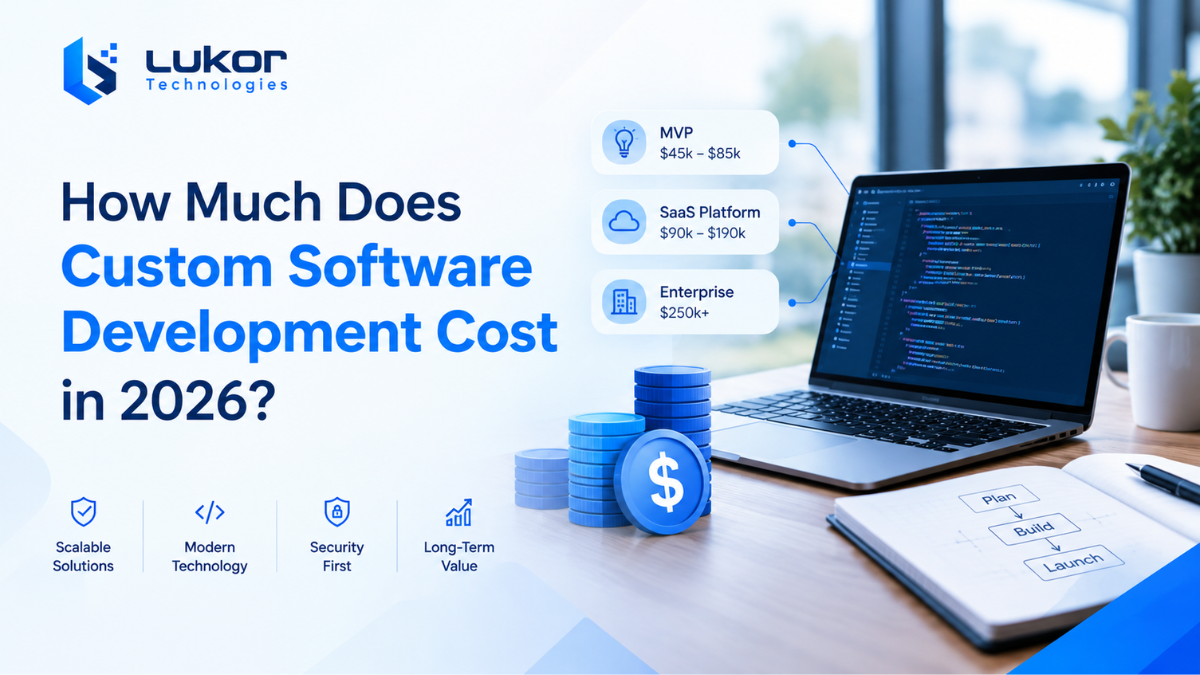
Custom software development can cost anywhere from around $10,000 for a focused MVP or internal tool to $500,000 or more for a complex enterprise platform in 2026. The actual cost depends on factors such as project scope, features, software complexity, integrations, technology stack, security requirements, development team, and ongoing support.
There is no universal price for custom software development. Understanding what custom software development involves can help businesses determine whether a purpose-built solution is right for their needs. A simple business application with a few workflows may require a much smaller budget than a multi-tenant SaaS platform, enterprise system, or AI-powered application. As functionality, integrations, scalability, and security requirements increase, so does the development effort and overall cost.
The broader technology market also continues to expand in 2026. Gartner forecasts worldwide IT spending at $6.37 trillion in 2026, including approximately $1.47 trillion in software spending. Gartner also forecasts $2.67 trillion in worldwide AI spending in 2026, highlighting the growing investment in software and AI-powered solutions.
In this guide, you’ll learn how much custom software development costs in 2026, what factors affect the price, how custom software development hourly rates work, which pricing models are available, what is included in a development estimate, and how to create a realistic custom software development budget.
How Much Does Custom Software Development Cost in 2026?
The custom software development cost in 2026 typically ranges from around $10,000 for a simple application to $500,000+ for large enterprise software. The actual cost depends on project complexity, features, integrations, technology, security, scalability, and development effort.
| Project Complexity | Indicative Cost Range | Typical Timeline |
|---|---|---|
| Simple software / focused MVP | $10,000–$30,000 | 2–4 months |
| Medium-complexity software | $30,000–$100,000 | 4–8 months |
| Complex software | $100,000–$300,000+ | 8–12+ months |
| Enterprise software | $300,000–$500,000+ | 12+ months |
These are indicative planning ranges, not fixed prices or quotations. Actual costs can vary significantly depending on the project’s scope, features, team, technology, integrations, and business requirements.
For example:
- A small internal workflow application may require a relatively limited investment.
- A CRM, business management platform, or SaaS product can require tens of thousands of dollars or more.
- A complex enterprise platform with extensive integrations, advanced security, and scalability requirements can require hundreds of thousands of dollars.
The most accurate custom software development estimate comes from a clearly defined scope, detailed requirements, and an assessment of the development effort required.
Custom Software Development Cost by Project Complexity
Project complexity is one of the key factors influencing custom software development cost. The number of features, workflows, integrations, users, security requirements, and scalability needs can significantly affect both budget and timeline.
Simple Software
Simple software typically has a limited number of screens, user roles, workflows, and integrations.
Examples:
- Internal business tools
- Employee portals
- Simple booking systems
- Basic inventory tools
- Customer portals
- Reporting dashboards
- Workflow automation tools
Indicative cost: $10,000–$30,000
Typical timeline: 2–4 months
A simple application may include authentication, a database, basic dashboards, forms, reporting, and standard business workflows.
Medium-Complexity Software
Medium-complexity software typically includes multiple user roles, customized business logic, more advanced workflows, and third-party integrations.
Examples:
- CRM platforms
- Business management systems
- E-commerce platforms
- Logistics software
- Healthcare applications
- SaaS products
Indicative cost: $30,000–$100,000
Typical timeline: 4–8 months
Costs can increase when the project requires advanced permissions, multiple integrations, automation, real-time functionality, or complex dashboards.
Complex Software
Complex software requires more advanced architecture, integrations, security, scalability, and testing.
Examples:
- Large SaaS platforms
- FinTech applications
- Healthcare platforms
- Supply chain systems
- Multi-tenant applications
- AI-powered business platforms
- Enterprise management systems
Indicative cost: $100,000–$300,000+
Typical timeline: 8–12+ months
These projects may require a multidisciplinary team of developers, architects, UI/UX designers, QA engineers, DevOps specialists, security professionals, and project managers.
Enterprise Software
Enterprise software typically involves complex business processes, multiple systems, large user bases, advanced security, and long-term scalability.
Examples:
- ERP systems
- Enterprise CRM platforms
- Supply chain management systems
- Healthcare platforms
- Financial systems
- Enterprise workflow platforms
Indicative cost: $300,000–$500,000+
Typical timeline: 12+ months
Costs can exceed these ranges when projects involve extensive data migration, legacy-system integration, multiple business units, regulatory requirements, or global deployment.
What Factors Affect Custom Software Development Cost?
There is no fixed custom software development price because every project has different requirements. Scope, complexity, features, technology, integrations, security, team expertise, testing, and ongoing support all influence the final custom software development cost.
Project Scope and Requirements
Project scope determines how much software needs to be designed, developed, tested, and deployed. It may include:
- User roles and workflows
- Features and admin functionality
- Reports and automation
- Third-party integrations
- Security and scalability
- Web or mobile platforms
A clearly defined scope helps create a more accurate custom software development estimate, while frequent changes can increase cost and delivery time.
Software Complexity
Simple applications with standard workflows generally require less development effort than systems with complex business logic, real-time processing, advanced permissions, or large-scale data requirements.
Key factors include business rules, user roles, data relationships, real-time functionality, multi-tenancy, automation, scalability, and security.
Number and Type of Features
Every feature adds design, development, testing, and maintenance effort. Common features include authentication, dashboards, notifications, payments, reports, file management, messaging, and workflow automation.
Advanced capabilities such as AI agents, predictive analytics, recommendation engines, and real-time communication can require significantly more development effort.
UI/UX Design Requirements
Customized software usually requires more design work than applications using standard layouts. UI/UX may include user journeys, wireframes, prototypes, visual design, responsive layouts, and usability testing.
A well-planned design process can identify usability issues early and reduce costly rework during development.
Technology Stack
The technology stack affects development effort, performance, scalability, security, and long-term maintenance. It can include programming languages, frameworks, databases, cloud platforms, APIs, AI technologies, and DevOps consulting.
The right stack should be selected based on project requirements and long-term goals rather than simply choosing the newest technology.
Third-Party Integrations
Integrations with payment gateways, CRM and ERP systems, accounting platforms, authentication providers, communication APIs, cloud services, and AI platforms can increase project scope.
Cost depends on API complexity, authentication, data mapping, error handling, documentation, and testing requirements.
Security and Compliance Requirements
Software handling sensitive or regulated data may require additional security measures, increasing development effort and cost.
Requirements may include secure authentication, role-based access control, encryption, audit logs, secure APIs, vulnerability testing, backups, and security monitoring. Industry-specific or regional compliance requirements can add further development and testing work.
Development Team Location and Experience
Development rates vary based on location, expertise, specialization, team structure, and engagement model. However, hourly rates alone do not determine total development cost. A lower rate may result in a higher overall cost if the project requires more hours or rework.
Consider technical expertise, relevant project experience, development processes, communication, project management, and post-launch support when selecting a team.
Testing and Quality Assurance
Testing helps ensure that software works reliably across different environments. Depending on the project, QA may include functional, integration, regression, performance, compatibility, security, and user acceptance testing.
More complex applications generally require broader testing coverage, increasing the overall development effort.
Maintenance and Support
Software development costs continue after launch. Ongoing expenses may include bug fixes, security updates, performance optimization, infrastructure management, monitoring, API updates, new features, and technical support.
Including these expenses in your custom software development budget provides a more realistic view of the software’s total cost over time.
Custom Software Development Cost by Development Type
The type of software you build is another major factor affecting the overall custom software development cost. Different software types require different technologies, features, architecture, integrations, and levels of scalability.
Web Application Development
Web application development can range from simple customer portals to complex enterprise platforms.
Cost is influenced by:
- Number of workflows and user roles
- Front-end and back-end complexity
- Database architecture
- Third-party integrations
- Security and scalability requirements
A focused web application may require a smaller investment, while a large SaaS or enterprise platform can require significantly more development effort.
Mobile Application Development
Mobile app development costs vary depending on whether you build for iOS, Android, or both platforms.
Features such as payments, push notifications, location services, offline functionality, real-time communication, camera access, and device integrations can increase development effort.
SaaS Product Development
SaaS products often require specialized architecture to support multiple customers on a shared platform.
Common requirements include:
- Multi-tenant architecture
- Subscription and billing management
- User roles and permissions
- Analytics and admin dashboards
- APIs and integrations
- Cloud infrastructure
- Security and scalability
The number of users, workflows, integrations, and scalability requirements can significantly affect the overall project cost.
Enterprise Software Development
Enterprise software typically involves extensive customization, complex workflows, and integration with existing business systems.
Examples include:
- ERP and CRM systems
- Supply chain platforms
- Business intelligence solutions
- Healthcare software development
- Financial applications
Legacy-system integration, data migration, advanced permissions, security, and high availability can substantially increase development effort.
AI-Powered Software Development
AI-powered software development can require additional work for data preparation, model integration, AI workflows, infrastructure, testing, and monitoring.
Common examples include:
- AI chatbots and virtual assistants
- Generative AI applications
- AI agents
- Recommendation systems
- Predictive analytics
- Document processing
- Natural language applications
- Computer vision solutions
The custom software development cost depends on the AI approach, such as using an existing API, retrieval-augmented generation (RAG), fine-tuning, proprietary data, or a more complex AI architecture.
Custom Software Development Hourly Rates in 2026
Custom software development hourly rates vary based on location, developer experience, technical specialization, company type, project complexity, and engagement model. As a result, there is no single global hourly rate for custom software development.
The following ranges provide a broad 2026 planning reference for software development services across major markets:
| Development Market | Indicative 2026 Hourly Range |
|---|---|
| India | $25–$75/hour |
| Latin America | $35–$95/hour |
| Eastern Europe | $35–$90/hour |
| Western Europe | $70–$180/hour |
| North America | $100–$250+/hour |
These are indicative market ranges, not standardized rate cards or quotations. Published 2026 pricing guides show that rates can vary significantly within each region based on developer seniority, specialization, agency versus freelance engagement, technology, and project requirements.
For example, current 2026 sources place Indian development rates broadly around $25–$75 per hour, while North American rates can reach $100–$250+ per hour for experienced or specialized development work.
The hourly rate should not be the only factor when comparing development providers. A lower hourly rate may not result in a lower total project cost if the project requires more development hours, additional management, rework, or specialized expertise.
A simple way to estimate development cost is:
Estimated Project Cost = Estimated Development Effort × Applicable Hourly Rate + Additional Project Costs
Additional costs may include UI/UX design, project management, quality assurance, infrastructure, third-party services, security, deployment, and post-launch support.
Custom Software Development Pricing Models
The custom software development pricing model can affect how costs are estimated, managed, and adjusted throughout a project. The most common models are fixed-price, time and materials, and dedicated development teams.
Fixed-Price Development
With a fixed-price model, the scope, deliverables, timeline, and agreed price are defined before development begins.
This model can work well when:
- Requirements are clearly defined
- Scope is relatively stable
- Deliverables are measurable
- The project roadmap is predictable
Changes outside the agreed scope may require additional time or a change in budget.
Time and Materials
With a time-and-materials model, the client pays based on the actual development effort and resources used.
It can be suitable when:
- Requirements may evolve
- Features are developed iteratively
- Priorities may change
- The project involves ongoing experimentation
This approach provides greater flexibility but requires regular tracking of scope, effort, and budget.
Dedicated Development Team
A dedicated development team provides a group of specialists who work on the product over an extended period. Depending on the project, the team may include:
- Software developers
- UI/UX designers
- QA engineers
- DevOps engineers
- Business analysts
- Project managers
This model can suit long-term product development, continuous improvements, and businesses that require dedicated technical resources.
The right custom software development pricing model depends on your project’s scope, requirements, flexibility, timeline, and long-term development needs.
What Is Included in a Custom Software Development Cost?
A complete custom software development cost breakdown can include several stages beyond software coding. The exact scope depends on the project’s requirements, complexity, technology, and development approach.
Business Analysis and Requirements
The team analyzes business goals, target users, workflows, functional requirements, technical needs, and project scope to establish a clear development plan.
UI/UX Design
This stage may include user flows, wireframes, prototypes, responsive layouts, and final interface designs focused on usability and user experience.
Architecture and Technical Planning
Technical teams define the application architecture, database structure, APIs, technology stack, security requirements, cloud infrastructure, and scalability approach.
Front-End and Back-End Development
Developers build the user interface, business logic, APIs, databases, authentication, integrations, and other core functionality required by the software.
Quality Assurance and Testing
QA teams test the application for functionality, usability, compatibility, performance, security, and reliability to identify and resolve issues before launch.
Deployment and Production Setup
The software is configured and deployed to the required hosting or cloud environment, including production configuration and necessary deployment setup.
Project Management
Project management covers requirements coordination, team management, communication, progress tracking, risk management, timelines, and delivery.
Documentation
Technical and operational documentation can cover system architecture, APIs, configurations, deployment procedures, and other information needed for future maintenance.
Post-Launch Support
Depending on the agreement, post-launch services may include bug fixes, monitoring, security updates, maintenance, technical support, and future enhancements.
The final custom software development cost depends on the services included, project complexity, development effort, technology requirements, and level of ongoing support.
Additional Costs to Consider
The initial development quotation does not always represent the full cost of operating and maintaining custom software. Consider these additional expenses when planning your budget.
Software Maintenance and Support
Post-launch maintenance may include:
- Bug fixes
- Security and framework updates
- Performance optimization
- Monitoring
- Technical support
Cloud Hosting and Infrastructure
Depending on the architecture and usage, you may pay for:
- Compute and storage
- Databases and backups
- Content delivery
- Monitoring and security services
Cloud costs vary based on traffic, data volume, infrastructure configuration, and usage.
Third-Party APIs and Services
External services may charge based on usage, transactions, subscriptions, or API calls. Examples include payment gateways, communication APIs, maps, analytics tools, authentication services, and AI APIs.
Security and Compliance
Security audits, penetration testing, monitoring, compliance requirements, and additional security controls can create costs beyond the initial development.
Updates and New Features
Software often needs to evolve after launch. New business requirements, user feedback, market changes, and technology updates may require additional development work.
Planning for these expenses from the beginning helps create a more realistic custom software development budget and avoids unexpected costs after launch.
What Is the Total Cost of Ownership of Custom Software?
The initial development invoice represents only part of the software’s overall cost. Businesses should also consider the expenses required to operate, maintain, secure, and improve the software after launch.
Total Cost of Ownership (TCO) = Initial Development + Infrastructure + Maintenance + Support + Third-Party Services + Future Enhancements
For example, a business may invest $50,000 in developing an application and continue spending on hosting, security, monitoring, maintenance, support, and new features after launch.
Ongoing costs vary based on the software’s architecture, traffic, complexity, third-party dependencies, support requirements, and future development needs.
Including these expenses in the initial software development budget provides a more realistic view of the software’s long-term investment and helps make costs more predictable.
How to Estimate Your Custom Software Development Cost
A reliable custom software development estimate should be based on your project’s scope, requirements, and development effort rather than a generic industry average.
1. Define Your Business Requirements
Identify the business problem, target users, key workflows, desired outcomes, and required platforms. Clear requirements provide a strong foundation for accurate cost estimation.
2. Determine the Required Features
Separate features into:
- Must-have features
- Important features
- Future enhancements
This helps define a realistic scope for the initial release.
3. Choose the Software Platform
Determine whether you need web, mobile, desktop, SaaS, enterprise software, or a combination of platforms. Each platform can require different development resources and effort.
4. Identify Integrations and Technical Requirements
List the technical requirements, including:
- APIs and payment systems
- CRM or ERP integrations
- Authentication
- Cloud services and databases
- AI services
- Data migration
Identifying these requirements early helps prevent unexpected costs later.
5. Estimate Development Effort
Break the project into major work areas such as:
- Discovery and planning
- UI/UX design
- Development
- Integrations
- Testing
- Deployment
- Project management
Estimate the effort required for each area to build a more realistic project cost.
6. Select a Pricing Model
Choose a development pricing model based on how clearly defined and flexible your requirements are. Common options include fixed-price, time and materials, and dedicated development teams.
7. Include Additional Costs
Your budget should account for testing, deployment, cloud infrastructure, third-party services, maintenance, technical support, and future enhancements.
8. Add a Contingency
Allow room for unexpected technical dependencies, scope adjustments, or requirement changes. A reasonable contingency can help prevent budget overruns.
A structured estimation process gives you a clearer view of your custom software development cost and helps you plan your budget with greater confidence.
How to Reduce Custom Software Development Costs
Reducing custom software development costs does not always mean choosing the lowest hourly rate. A better approach is to control scope, minimize rework, and prioritize investments that deliver the most business value.
Prioritize Essential Features
Focus first on features that directly support your core business goals. Non-essential functionality can be added in later phases.
Start With an MVP
An MVP allows you to launch the core product with essential features, gather user feedback, and validate the concept before investing in advanced functionality.
Define Clear Requirements
Well-defined requirements reduce ambiguity, scope changes, and rework, helping keep both development costs and timelines under control.
Choose the Right Technology Stack
Select technologies based on your software’s performance, security, scalability, hiring, and long-term maintenance requirements rather than simply choosing the latest tools.
Reuse Proven Components
Established frameworks, libraries, APIs, and reusable components can reduce development effort and cost when they are suitable for the project.
Plan Integrations Early
Identify third-party integrations and technical dependencies before development begins. Early planning helps avoid unexpected development work and delays.
Develop in Phases
Breaking a larger project into manageable phases allows you to prioritize essential functionality and distribute development investment over time.
Work With an Experienced Development Team
An experienced team can help identify technical risks, refine requirements, select an appropriate architecture, and create a realistic development plan that helps prevent unnecessary costs.
How to Choose a Custom Software Development Company
Choosing the right custom software development company can affect your project’s cost, quality, delivery timeline, security, and long-term maintenance. Before selecting a development partner, evaluate the following factors.
Technical Expertise
Check whether the team has proven experience with the technologies, platforms, and integrations your project requires.
Relevant Industry Experience
Industry experience can help developers better understand your business workflows, user needs, integrations, security requirements, and regulatory considerations.
Portfolio and Case Studies
Review previous projects and case studies to evaluate the company’s technical capabilities, problem-solving approach, and experience with similar software solutions.
Development Process
Understand how the company handles requirements, planning, development, testing, feedback, and scope changes. A clear development process helps reduce delays and unexpected costs.
Communication and Project Management
Effective communication is essential for keeping the project aligned with its scope, timeline, responsibilities, and budget. Ask about communication channels, reporting, meetings, and project management practices.
Security Practices
Ask how the company handles authentication, authorization, data protection, secure coding, vulnerability testing, backups, and monitoring, especially if your software handles sensitive information.
Post-Launch Support
Find out what support is provided after launch, including bug fixes, maintenance, monitoring, security updates, technical support, and future enhancements.
Transparent Pricing
A reliable proposal should clearly outline:
- Project scope and deliverables
- Technology and team structure
- Development timeline
- Pricing model and payment terms
- Testing and deployment
- Maintenance and support
When comparing proposals, look beyond the final price. Evaluate what is included, how the project will be delivered, and what ongoing support the provider offers.
Conclusion
The answer to “How much does custom software development cost in 2026?” depends primarily on what you need to build.
As a planning reference, a focused MVP or internal application may start around $10,000–$30,000, medium-complexity software may fall around $30,000–$100,000, complex applications can reach $100,000–$300,000+, and enterprise platforms can require $300,000–$500,000+ or more.
These figures are planning ranges rather than fixed prices. The final custom software development cost depends on the project’s scope, features, integrations, technology, security, development team, infrastructure, and long-term requirements.
The best way to control the budget is to define the requirements clearly, prioritize essential features, select an appropriate technology stack and pricing model, and account for testing, deployment, maintenance, and future development from the beginning.
Lukor Technologies helps businesses plan and build custom software solutions around their business objectives, workflows, technical requirements, and growth plans. From requirements analysis and UI/UX design to development, integrations, testing, deployment, and ongoing support, the right development approach can turn a software idea into a scalable digital product.
Ready to discuss your software project? Contact Lukor Technologies to define your requirements and request a project estimate.
Frequently Asked Questions
How much does custom software development cost in 2026?
Custom software development can range from around $10,000 for a focused MVP or internal tool to $500,000 or more for complex enterprise systems. The actual price depends on scope, features, integrations, technology, security, development team, and scalability requirements. Current industry guides show wide variations because projects differ substantially in scope.
How long does it take to develop custom software?
A focused MVP may take around 2–4 months, a medium-complexity application around 4–8 months, and a complex or enterprise platform 8–12 months or longer. The actual timeline depends on requirements, team size, integrations, testing, data migration, and client-side dependencies.
What factors affect custom software development costs?
The main factors include project scope, software complexity, feature count, user roles, UI/UX requirements, technology stack, third-party integrations, security, compliance, development team rates, testing, infrastructure, and ongoing maintenance.
How are custom software development costs calculated?
A development company typically defines the scope, breaks the project into features and technical tasks, estimates the required effort, applies the relevant team rates, and accounts for design, QA, project management, deployment, infrastructure, and other required services.
Is custom software more expensive than off-the-shelf software?
Custom software often requires a larger initial investment because it is designed specifically around a business’s requirements. However, the appropriate option depends on the required functionality, customization, integrations, scalability, ownership, and long-term business needs.
How much does it cost to maintain custom software?
There is no universal maintenance price. Costs depend on application complexity, infrastructure, usage, support requirements, security needs, and how frequently the software is updated. A long-term budget should account for maintenance, hosting, monitoring, security updates, support, and future improvements.
What is the average hourly rate for custom software development?
Published 2026 industry guides show broad ranges rather than a single standard rate. India-based agencies are commonly reported around $25–$75 per hour, while North American providers may range from roughly $100–$250+ per hour depending on the provider and work involved.
Can I reduce custom software development costs by starting with an MVP?
Yes. An MVP focuses on the essential functionality needed to launch and validate the product. Businesses can then prioritize additional features based on user feedback, business performance, and future requirements.
What should I include when requesting a custom software development quote?
Provide as much information as possible about your target users, business objectives, features, platforms, integrations, security requirements, expected users, preferred timeline, and existing systems. A clearer project brief allows development companies to produce more meaningful estimates.
Does AI make custom software development cheaper?
AI-assisted development can improve productivity for certain tasks, but production software still requires architecture, requirements analysis, code review, security, testing, integration, deployment, and ongoing maintenance. Therefore, AI does not create a universal percentage reduction in custom software development costs.