Intoruction
Businesses today need software that can adapt to unique workflows, integrate with existing systems, automate repetitive processes, and support long-term growth. At the same time, artificial intelligence is transforming how modern software is designed, developed, and used. A 2026 JetBrains survey of more than 15,000 professional developers found that 90% of professional developers use AI coding agents at work at least weekly, while 68% use them daily.
AI is also becoming increasingly integrated into business applications. Gartner’s 2026 technology outlook projects that 40% of enterprise applications will integrate task-specific AI agents by the end of 2026, highlighting the growing role of intelligent software in business operations.
As technology continues to evolve, businesses are looking for software that is scalable, secure, flexible, and aligned with their specific requirements. While off-the-shelf software can address common business needs, it may not provide the customization, integrations, or flexibility required for specialized workflows and evolving business objectives.
This is where custom software development provides a tailored approach. Instead of adapting business processes to fit a pre-built product, organizations can develop software around their specific requirements, users, technology environment, and long-term goals.
From enterprise platforms and web applications to mobile apps, cloud solutions, workflow automation, and AI-powered applications, custom software can support a wide range of business needs. Lukor Technologies helps businesses build tailored digital solutions designed around their workflows, integrations, technology requirements, and growth objectives.
In this guide, we’ll explore what custom software development is, its types, benefits, common solutions, development process, costs, technologies, use cases, and future trends.
What Is Custom Software Development?
Custom software development is the process of designing, building, testing, deploying, and maintaining software specifically for the requirements of a particular business, organization, or user group.
Unlike off-the-shelf software, which is created for a broad market, custom software is developed around specific business processes, operational requirements, user needs, integrations, security requirements, and growth objectives.
For example, a business may need a software platform that connects its CRM, accounting system, inventory database, customer portal, and internal workflows. Instead of relying on multiple disconnected applications, custom software can bring these requirements together into a unified solution.
Custom software development can involve web applications, mobile applications, enterprise platforms, cloud-based systems, SaaS products, workflow automation tools, data platforms, and AI-powered applications.
How Does Custom Software Development Work?
A typical custom software development process follows a structured software development lifecycle, taking a project from initial requirements through development, launch, and ongoing improvement.
- Discovery and Requirements Analysis – Identify business goals, target users, workflows, functional requirements, technical needs, integrations, and project objectives.
- Planning and Technical Architecture – Define the development roadmap, technology stack, system architecture, database structure, integrations, security requirements, and scalability considerations.
- UI/UX Design – Create user flows, wireframes, prototypes, and intuitive interfaces based on user needs and business requirements.
- Software Development – Build the frontend, backend, APIs, databases, integrations, and other required functionality according to the approved architecture and designs.
- Testing and Quality Assurance – Test the software for functionality, performance, security, usability, compatibility, and integration issues, then resolve identified problems.
- Deployment and Launch – Deploy the tested application to its production environment and configure the required infrastructure, databases, security controls, and monitoring.
- Maintenance and Continuous Improvement – Monitor the software, apply security and technical updates, fix issues, optimize performance, and introduce new features as business requirements evolve.
This approach allows the software to evolve as business requirements change.
Custom Software vs. Off-the-Shelf Software
The main difference between custom and off-the-shelf software is how the product is designed and delivered.
| Factor | Custom Software | Off-the-Shelf Software |
|---|---|---|
| Development | Built for specific requirements | Built for a broad market |
| Customization | Highly flexible | Usually limited to available features |
| Integrations | Can be designed around required systems | Depends on supported integrations |
| Scalability | Can be planned around business growth | Depends on the product’s capabilities |
| User experience | Designed for specific users and workflows | Standardized experience |
| Ownership | May provide greater control over the solution | Controlled by the software vendor |
| Initial investment | Generally higher | Usually lower |
| Long-term flexibility | High | Depends on vendor roadmap |
Off-the-shelf software can be suitable when a business has straightforward requirements and wants a ready-to-use solution. Custom software may be more appropriate when the organization has complex processes, specialized requirements, multiple integrations, or long-term scalability needs.
Types of Custom Software Development
Custom software can take many forms depending on business requirements, target users, industry needs, and technology environments. The right approach depends on the problems the software must solve, the systems it must integrate with, and how it may need to scale over time.
1. Custom Enterprise Software
Custom enterprise software is designed to support complex business operations across departments, locations, or business units.
These solutions can help organizations manage workflows, data, employees, customers, financial processes, supply chains, and internal operations through centralized platforms.
Examples include:
- Enterprise resource planning systems
- Business management platforms
- Internal operations software
- Employee management systems
- Supply chain platforms
- Enterprise data platforms
2. Custom Web Applications
Custom web applications are browser-based software solutions designed around specific business requirements and user workflows. They can be accessed across supported devices and operating systems without requiring users to install traditional desktop software.
Businesses can use web applications for customer portals, internal dashboards, marketplaces, booking systems, SaaS platforms, e-commerce solutions, and other digital services. Organizations looking to build tailored browser-based solutions can explore custom web development services designed around their application and business requirements.
Because web applications can be built around specific workflows, they can provide functionality beyond what generic website builders or standard software products typically offer.
3. Custom Mobile Applications
Custom mobile application development involves creating applications specifically around business requirements, user needs, and mobile use cases.
Depending on the project, businesses may develop native iOS or Android applications, cross-platform applications, or mobile solutions connected to existing web and enterprise systems. Custom mobile app development can support applications that require specialized functionality, integrations, secure data access, or a tailored user experience.
Common applications include:
- Customer-facing mobile apps
- Employee applications
- Field-service applications
- Healthcare applications
- E-commerce apps
- On-demand service platforms
- Business productivity apps
4. Custom Cloud-Based Software
Cloud-based custom software is designed to operate using cloud infrastructure and services, allowing organizations to build applications that can support remote access, scalability, centralized data management, and integration with other cloud services.
Organizations can build cloud-based applications for business operations, data management, SaaS products, collaboration, analytics, and customer-facing services. Cloud environments can also be supported by DevOps consulting services to improve deployment processes, infrastructure management, automation, scalability, and software delivery.
5. AI-Powered Custom Software
AI-powered custom software combines traditional application functionality with artificial intelligence to support intelligent features, automation, data processing, and decision-support capabilities.
Depending on the business objective, these solutions may incorporate:
- Generative AI
- AI agents
- Machine learning
- Natural language processing
- Predictive analytics
- Recommendation systems
- Intelligent search
- Conversational AI
- Document and data processing
Businesses can integrate AI into existing applications or incorporate intelligent capabilities into a new software platform from the beginning. AI development services can be used to build AI-powered applications around specific business workflows, data, and use cases.
6. Industry-Specific Software
Industry-specific software is designed around the workflows, regulations, data requirements, and operational needs of a particular sector.
Examples include:
- Custome Healthcare software
- Financial services software
- Manufacturing software
- Logistics and transportation software
- Retail software
- Education software
- Real estate software
- Professional services software
These solutions can provide specialized functionality that general-purpose software may not offer, helping organizations align their technology more closely with industry-specific processes and requirements.
Common Custom Software Solutions
Custom software development can address a wide variety of business requirements. Some common solutions include:
CRM Software
Custom CRM software can help organizations manage customer information, sales activities, communications, leads, opportunities, and customer interactions according to their specific sales processes.
ERP Software
Custom ERP solutions can connect business functions such as finance, inventory, procurement, operations, human resources, and supply chain management.
SaaS Platforms
Businesses can develop custom SaaS applications for customers or internal teams. These platforms can be designed around specific subscription models, user roles, workflows, integrations, and product requirements.
Workflow Automation Software
Workflow automation solutions can digitize repetitive processes, route tasks between teams, trigger notifications, and reduce manual administrative work.
Customer Portals
Custom customer portals can provide users with secure access to account information, documents, orders, support requests, payments, reports, or other services.
Data Analytics Platforms
Businesses can develop custom analytics platforms that collect information from multiple systems and present it through dashboards, reports, visualizations, and business intelligence tools.
AI-Powered Business Solutions
AI-powered software can help businesses automate information processing, support customer interactions, analyze data, generate content, assist employees, and create intelligent workflows.
Benefits of Custom Software Development
The main advantage of custom software is the ability to create a solution around specific business requirements rather than forcing existing processes into a standardized product.
1. Built Around Business Requirements
Custom software is designed around an organization’s specific workflows, processes, users, and business objectives. This approach allows businesses to prioritize the features and functionality that are most relevant to their operations while avoiding unnecessary capabilities found in generic software.
2. Greater Flexibility and Customization
Custom software gives businesses greater control over features, workflows, user roles, interfaces, integrations, and system behavior. As business requirements evolve, the software can be modified and expanded to support new processes, features, and operational needs.
3. Improved Scalability
Custom applications can be architected with future growth in mind. Development teams can plan for changes in user numbers, transaction volumes, data requirements, integrations, geographic expansion, and functionality from the early stages of the project.
4. Better Integration With Existing Systems
Businesses often use multiple platforms for CRM, accounting, payments, communication, analytics, inventory, and other operations. Custom software can be developed to integrate with these systems through APIs and other integration technologies, helping businesses create a more connected and efficient technology environment.
5. Enhanced Security Control
Security requirements can be considered throughout the software architecture and development lifecycle. Depending on the application’s requirements, custom solutions can incorporate authentication, authorization, encryption, access controls, audit logging, secure APIs, vulnerability testing, and monitoring.
Security measures should be designed according to the application’s data, users, business requirements, industry standards, and applicable regulations.
6. Improved User Experience
Custom software can be designed around the people who will use it and the tasks they need to complete. Instead of requiring users to navigate a generic interface, organizations can create experiences tailored to specific roles, workflows, permissions, and business processes.
7. Long-Term Flexibility
A custom software solution can evolve as business requirements change. Organizations can introduce new features, update integrations, automate additional workflows, incorporate AI capabilities, or improve the user experience without being entirely dependent on the development roadmap of a third-party software provider.
8. Competitive Differentiation
Software can become an important part of how a business delivers its products, services, and customer experiences. When a solution supports unique workflows, specialized capabilities, or differentiated customer interactions, it can help businesses build technology that aligns closely with their operating model and strategic objectives.
Applications of Custom Software Development
Custom software development can be applied across industries and business functions to support specialized workflows, improve system integration, and address requirements that standard software may not fully cover. Common applications include:
Business Process Automation
Custom software can automate repetitive and time-consuming tasks such as approvals, notifications, data entry, document processing, reporting, and workflow management. This can help organizations create more consistent and structured business processes.
Customer Relationship Management
Custom CRM software can be designed around specific sales and customer management processes. It can support lead management, customer profiles, communication tracking, sales pipelines, support activities, reporting, and integration with other business systems.
E-commerce and Digital Platforms
Businesses can develop custom e-commerce platforms, marketplaces, booking systems, subscription platforms, customer portals, and other digital products. These solutions can be tailored to specific business models, customer journeys, payment requirements, and third-party integrations.
Healthcare
Healthcare organizations can use custom healthcare software for patient management, appointment scheduling, healthcare portals, telehealth, clinical workflows, reporting, and operational management. Solutions can also be designed around specific organizational processes and applicable data protection requirements.
Finance and Fintech
Custom software can support specialized financial workflows such as payment processing, customer onboarding, financial management, transaction processing, reporting, analytics, and account management. You can also integrate banking, payment, and other financial systems as needed.
Manufacturing
Manufacturing businesses can use custom applications to support production management, inventory control, quality processes, equipment monitoring, supply chain coordination, and operational reporting. Software can be integrated with existing enterprise and production systems where appropriate.
Logistics and Supply Chain
Custom logistics software can help manage fleet operations, shipment tracking, route planning, warehouse activities, order management, and supply chain visibility. Integrations with transportation, inventory, and other operational systems can support connected logistics workflows.
Custom Software Development Process
A well-planned custom software development process helps reduce project risks and creates a clear path from business requirements to a production-ready application.
1. Discovery and Requirements Analysis
The process begins by understanding the business problem, target users, and objectives of the software.
This stage may include:
- Business requirements
- User requirements
- Functional requirements
- Technical requirements
- Integration requirements
- Security considerations
- Project objectives
- Success criteria
2. Planning and Technical Architecture
The development team defines how the software will be structured and selects technologies based on the project’s functional, technical, and scalability requirements.
The architecture may cover:
- Frontend and backend
- APIs and databases
- Cloud infrastructure
- Third-party integrations
- Authentication and authorization
- Security
- Scalability
3. UI/UX Design
Designers create user flows, wireframes, prototypes, and interfaces based on the target users and business requirements. The goal is to create a user experience that is intuitive, accessible, and efficient while supporting the intended workflows.
4. Software Development
Developers build the application according to the approved architecture and designs. Development may include frontend and backend development, database implementation, API development, third-party integrations, cloud configuration, and AI functionality where required.
5. Testing and Quality Assurance
Testing helps identify defects and verify that the software meets its functional, technical, security, and performance requirements.
Testing may include:
- Functional testing
- Integration testing
- Performance testing
- Security testing
- Usability testing
- Compatibility testing
- User acceptance testing
6. Deployment and Launch
After testing and approval, the application is deployed to its production environment. Deployment may involve cloud infrastructure, servers, databases, domain configuration, monitoring, security controls, data migration, and release management.
7. Maintenance and Continuous Improvement
Software development does not necessarily end at launch. Ongoing maintenance helps keep the application secure, reliable, and aligned with changing business requirements. Maintenance may include security updates, bug fixes, performance improvements, infrastructure updates, monitoring, new integrations, and feature enhancements.
How Much Does Custom Software Development Cost?
The custom software development cost depends on several factors, including the complexity of the application, required functionality, technology stack, integrations, security requirements, development team, and project timeline.
A simple business application may require significantly less development effort than a large enterprise platform involving multiple systems, mobile applications, complex workflows, AI capabilities, or advanced analytics.
Key factors that can influence the cost of custom software development include:
- Number and complexity of features
- UI/UX design and customization requirements
- Web, mobile, or multi-platform development
- Backend architecture and database requirements
- Third-party integrations and APIs
- AI and machine learning functionality
- Cloud infrastructure and deployment requirements
- Security and compliance requirements
- Testing and quality assurance
- Development team expertise and location
- Ongoing maintenance and support
Rather than focusing only on the initial development cost, businesses should also consider the total cost of ownership (TCO). This may include infrastructure, maintenance, security updates, upgrades, integrations, and future feature development.
Because every custom software project has different requirements, an accurate estimate typically requires an assessment of the project’s scope, technical requirements, integrations, and expected functionality.
Technologies Used in Custom Software Development
The technology stack depends on the application’s requirements, performance expectations, users, integrations, and scalability needs.
Frontend Technologies
Common frontend technologies include:
- React
- Angular
- Vue.js
- HTML
- CSS
- JavaScript
- TypeScript
Backend Technologies
Backend development may use technologies such as:
- Node.js
- Python
- Java
- .NET
- PHP
- Go
Mobile Development
Mobile applications may be developed using:
- Swift
- Kotlin
- React Native
- Flutter
Databases
Depending on the application, databases may include:
- PostgreSQL
- MySQL
- Microsoft SQL Server
- MongoDB
- Redis
Cloud and Infrastructure
Custom applications can use cloud platforms and infrastructure services from providers such as AWS, Microsoft Azure, and Google Cloud.
AI and Machine Learning
AI-powered applications may incorporate machine learning frameworks, large language models, generative AI services, vector databases, AI APIs, and other intelligent technologies.
The technology stack should be selected based on the project’s actual requirements rather than simply following technology trends.
When Should You Choose Custom Software Development?
Custom software development may be worth considering when a business has requirements that existing products cannot adequately address.
You may consider custom software when:
- Existing software does not meet important business requirements.
- Business workflows are highly specialized.
- Multiple systems need to work together through integrations.
- The organization needs a platform designed for future growth.
- Security or data requirements require greater control.
- A specialized customer experience is important.
- The business plans to develop its own SaaS product.
- Manual processes are creating operational inefficiencies.
- AI needs to be integrated into specific business workflows.
- The organization requires greater control over its product roadmap.
However, custom development is not automatically the right choice for every business. If an existing software product already meets the required functionality at a reasonable total cost of ownership, an off-the-shelf solution may be a more practical option.
The decision should ultimately be based on business requirements, functionality, integration needs, scalability, security, budget, and long-term objectives.
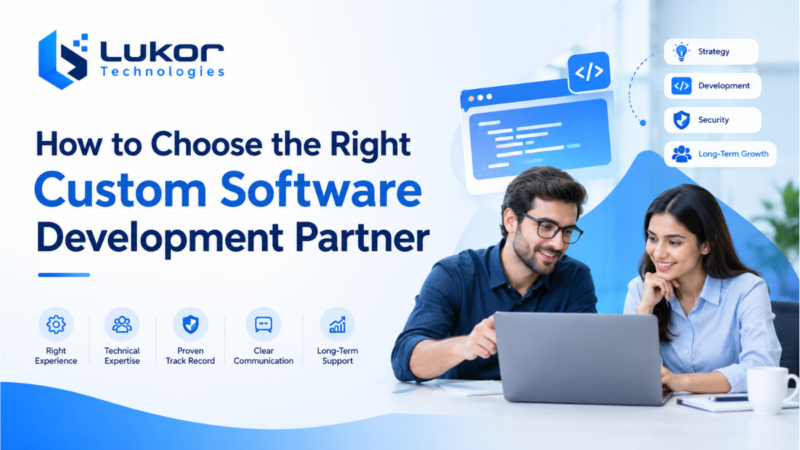
How to Choose a Custom Software Development Company
Choosing a custom software development company involves more than comparing development costs. Businesses should evaluate a potential development partner based on technical expertise, relevant experience, development practices, communication, security, and long-term support.
Consider the following factors:
Technical Expertise
Evaluate whether the development team has experience with the programming languages, frameworks, databases, cloud platforms, and other technologies required for your application.
Relevant Industry Experience
Experience with similar industries, business models, or workflows can help a development team understand specific requirements and potential technical challenges.
Portfolio and Case Studies
Review previous projects and case studies to understand the company’s technical capabilities, development experience, and approach to solving business problems.
Development Process
Understand how the company manages requirements, UI/UX design, development, testing, deployment, communication, and project management throughout the software development lifecycle.
Security Practices
Ask how the development team addresses application security, data protection, authentication, access control, vulnerability testing, and secure development practices.
Communication
Clear communication helps teams manage requirements, feedback, timelines, changes, and expectations throughout the project. Ask about communication channels, reporting practices, and how project updates are handled.
Post-Launch Support
Review the available maintenance and support services, including bug fixes, monitoring, security updates, performance improvements, integrations, and future feature development.
Scalability
The development partner should be able to design software that can evolve as users, data volumes, integrations, and business requirements grow.
Businesses evaluating providers such as Lukor Technologies can review their technical capabilities, relevant experience, development approach, portfolio, and post-launch support before selecting a development partner.
Conclusion
Custom software development enables businesses to create digital solutions around their specific workflows, users, technology requirements, integrations, and long-term objectives. From enterprise platforms and mobile applications to cloud systems, workflow automation, and AI-powered software, custom solutions can support a wide range of business needs.
The key is not simply to build more software, but to build software that solves a clearly defined business problem and can evolve as requirements change.
As AI, cloud computing, automation, and connected systems continue to develop through 2026 and beyond, businesses have more opportunities to create intelligent and scalable software experiences. Choosing the right technology, development process, architecture, and development partner can help turn those opportunities into practical digital solutions.
Lukor Technologies provides custom software development solutions designed around business requirements, technology needs, integrations, and long-term growth objectives. From software applications and enterprise platforms to AI-powered solutions, the right development approach can help organizations build technology that supports their evolving business needs.
Frequently Asked Questions
1. What is custom software development?
Custom software development is the process of designing and building software specifically around the requirements of a business, organization, or particular group of users.
2. What are the main types of custom software?
Common types include custom enterprise software, web applications, mobile applications, cloud-based software, AI-powered applications, SaaS platforms, and industry-specific software.
3. What are the benefits of custom software development?
Key benefits include greater customization, scalability, integration flexibility, improved user experience, enhanced control, and the ability to align software with specific business processes.
4. How long does custom software development take?
The timeline varies based on project complexity, features, integrations, platforms, team size, testing requirements, and technical architecture. A small application may take a few months, while a complex enterprise platform can require significantly longer.
5. Is custom software better than off-the-shelf software?
Neither option is universally better. The right choice depends on the organization’s requirements, budget, timeline, scalability needs, integrations, and long-term objectives.
6. How much does custom software development cost?
There is no single fixed price. Cost depends on functionality, complexity, technology, integrations, security requirements, development effort, and ongoing maintenance.
7. Can custom software integrate with existing business systems?
Yes. Custom software can be designed to integrate with existing systems using APIs, databases, middleware, webhooks, and other integration methods, depending on the systems involved.
8. Can AI be included in custom software?
Yes. AI can be integrated into custom applications through capabilities such as generative AI, AI agents, machine learning, intelligent search, recommendation systems, predictive analytics, and natural language processing.
9. How do I choose a custom software development company?
Evaluate technical expertise, relevant experience, portfolio, development methodology, security practices, communication, scalability capabilities, pricing, and post-launch support.
10. Is custom software suitable for small businesses?
It can be. Small businesses may consider custom development when their workflows are specialized, existing software does not meet important requirements, or they need a differentiated digital product. For straightforward needs, an off-the-shelf solution may be more appropriate.