
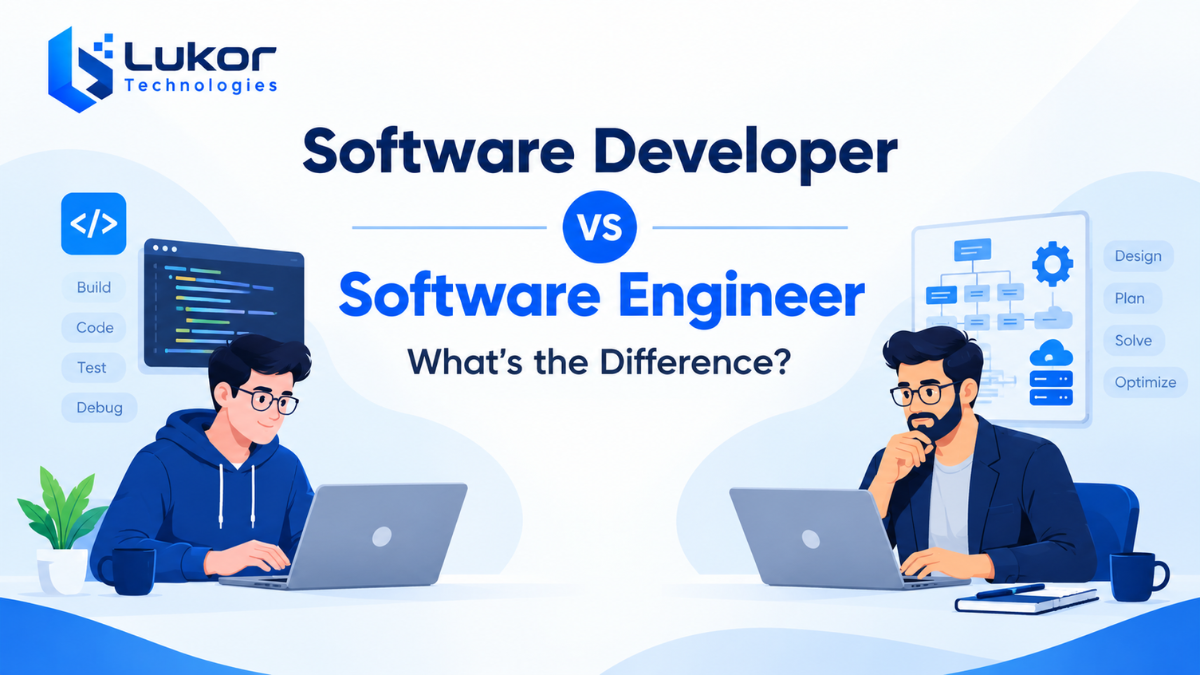
Software developers and software engineers are two of the most common roles in the technology industry. Both build, test, improve, and maintain software, but their responsibilities can vary depending on the company, project, and experience level.
As software development continues to evolve in 2026, AI-assisted development is also becoming an important part of modern engineering workflows. Stack Overflow’s 2026 Developer Survey found that 83% of respondents use at least one AI tool, while 73% of AI coding-assistant and agent users use them daily.
Generally, software developers focus more on building and maintaining applications and features, while software engineers may take a broader approach that includes system design, architecture, scalability, reliability, and technical decisions.
However, the distinction is not absolute. Many companies use the terms software developer and software engineer interchangeably, so understanding the actual responsibilities is more important than the job title.
Quick Answer: Software Developer vs Software Engineer
The main difference between a software developer and a software engineer is usually the scope of responsibility.
A software developer typically focuses on designing, coding, testing, debugging, and maintaining software applications. A software engineer may perform these same tasks while also working on system architecture, scalability, performance, reliability, security, and larger technical decisions.
In practice, the roles overlap significantly. A developer can work on system design, and an engineer can spend much of their time writing application code. The difference depends largely on the organization’s job structure and the individual’s responsibilities.
What Is a Software Developer?
A software developer is a professional who designs, builds, tests, and maintains software applications. They turn business or product requirements into functional software by writing code, solving technical problems, and integrating different technologies.
Software developers work on web applications, mobile apps, desktop software, backend systems, APIs, and custom software development projects designed around specific business requirements.
Their work can include developing features, testing and debugging code, working with databases and APIs, integrating third-party services, and improving existing software. They also collaborate with product managers, designers, testers, and other technical teams throughout the development process.
The specific role varies by specialization. For example, a frontend developer focuses primarily on user interfaces, while a backend developer works with APIs, databases, server-side logic, and application infrastructure.
What Is a Software Engineer?
A software engineer is a professional who applies engineering principles to design, develop, test, deploy, and maintain software systems. Their work can include writing code as well as making broader technical decisions about how software should be designed and operated.
Software engineers may work with system architecture, scalability, reliability, performance, security, and technical planning, particularly when developing larger or more complex systems.
Their work can involve designing system components, developing and reviewing code, solving complex technical problems, improving performance and reliability, and evaluating technical trade-offs. They may also consider how different parts of a system communicate and how the software can scale as usage grows.
The role varies between organizations. Some software engineers focus mainly on application development, while others spend more time on architecture, infrastructure, system design, or technical strategy. As with software developers, the actual responsibilities often matter more than the job title.
Software Developer vs Software Engineer: Key Differences
The difference between a software developer and a software engineer is easier to understand when their typical areas of focus are compared.
| Area | Software Developer | Software Engineer |
|---|---|---|
| Primary focus | Building, improving, and maintaining software applications and features | Designing, building, and improving software systems and solutions |
| Typical scope | Features, applications, components, and application functionality | Applications, systems, architecture, and technical infrastructure |
| Coding | Core responsibility | Core responsibility |
| Software development | Develops and maintains software based on requirements | Develops software while considering broader system requirements |
| Testing & debugging | Tests, debugs, and fixes application issues | Tests, debugs, and evaluates system-level issues |
| System design | May contribute to application and component design | Often involved in system and technical design |
| Software architecture | May work within an established architecture | Often designs, evaluates, or improves architecture |
| Scalability | Considers scalability within assigned applications or features | Often plans for scalability across the broader system |
| Performance | Optimizes application and feature performance | Evaluates performance across systems and components |
| Reliability | Helps maintain reliable application functionality | Often considers reliability and failure handling at the system level |
| Security | Implements application-level security requirements | May address broader security architecture and system requirements |
| Technical decisions | Usually makes decisions within the assigned project or feature | May make broader technical and architectural decisions |
| Problem-solving | Primarily solves application and feature-level problems | May solve complex application, system, and architecture-level problems |
| Collaboration | Works with developers, designers, QA, product managers, and other teams | Often collaborates across engineering, product, infrastructure, security, and technical teams |
| Common skills | Programming, APIs, databases, testing, debugging, frameworks, and version control | Programming, system design, architecture, distributed systems, cloud, scalability, security, and performance |
| Career progression | Junior Developer → Developer → Senior Developer → Lead Developer | Junior Engineer → Software Engineer → Senior Engineer → Staff Engineer → Principal Engineer |
| Best suited for | People who enjoy building applications, features, and solving practical development problems | People interested in system design, architecture, scalability, reliability, and broader technical decisions |
| Important note | Responsibilities vary by company and job level | Responsibilities vary by company and job level |
Key takeaway: Software developers generally focus on building and maintaining software, while software engineers may take a broader approach involving architecture, scalability, reliability, and system-level decisions. However, the distinction varies by company and role.
These differences are general patterns, not strict industry definitions. Many companies use the terms software developer and software engineer interchangeably, while others define them based on different responsibilities or levels of technical scope.
Ultimately, the actual job responsibilities matter more than the title. A software developer may work on system architecture, while a software engineer may spend much of their time writing and maintaining application code.
Software Developer vs Software Engineer: Roles and Responsibilities
The roles of software developers and software engineers overlap in many areas, particularly in modern development teams. The main difference is often the scope of their responsibilities and the problems they solve.
Software Developer Role
A software developer typically focuses on turning requirements into working software. Their work can include:
- Designing application components
- Writing and maintaining code
- Creating and improving software features
- Testing and debugging applications
- Connecting APIs and databases
- Refactoring existing code
- Supporting software releases
Their work is often closely connected to the functionality, performance, and quality of the software being developed.
Software Engineer Role
A software engineer may perform many of the same development activities while also considering broader technical concerns.
Their work can include:
- Designing system architecture
- Choosing appropriate technical approaches
- Breaking complex systems into manageable components
- Planning for scalability
- Improving system reliability
- Evaluating performance
- Addressing security requirements
- Managing technical trade-offs
For example, when building a high-traffic application, a software engineer may need to consider database scaling, caching, service communication, failure handling, and overall system capacity in addition to writing code.
The distinction is not always strict. A software developer may work on architecture and system design, while a software engineer may spend much of their time coding. The actual responsibilities depend on the organization, project, and level of experience.
Software Developer vs Software Engineer: Skills
Both software developers and software engineers need strong technical and problem-solving skills. The specific skills required depend on the type of software, technology stack, project complexity, and level of experience.
Software Developer Skills
Common software developer skills include:
- Programming languages
- Data structures and algorithms
- Version control
- Databases
- APIs
- Software testing
- Debugging
- Development frameworks
- Problem-solving
- Collaboration
Developers also need practical knowledge of the tools, frameworks, and technologies used to build and maintain their applications.
Software Engineer Skills
Software engineer skills include many of the same technical foundations, along with skills related to designing and managing larger software systems.
Common areas include:
- Programming and software development
- Data structures and algorithms
- System design
- Software architecture
- Databases and APIs
- Distributed systems
- Cloud and infrastructure concepts
- Scalability and performance
- Security
- Problem-solving
- Technical decision-making
The key difference is not that software engineers simply need more skills than developers. Both roles require strong technical abilities. Software engineers may apply those skills more broadly to system design, architecture, scalability, reliability, and long-term technical decisions.
Software Developer vs Software Engineer: Career Path
Both software developer and software engineer careers can lead to senior technical, leadership, or specialized roles. The progression depends on the organization, experience, skills, and area of specialization.
A typical software developer career path may look like:
Junior Software Developer → Software Developer → Senior Software Developer → Lead Developer
A typical software engineering career path may look like:
Junior Software Engineer → Software Engineer → Senior Software Engineer → Staff Engineer → Principal Engineer
The demand for software professionals continues to grow. According to the U.S. Bureau of Labor Statistics (BLS), software developer employment is projected to grow 15.8% from 2024 to 2034, adding approximately 267,700 jobs. This reflects the continued need for professionals who can build and engineer modern software systems.
These career paths are not universal. Companies use different job titles and levels, and the responsibilities can overlap. A software developer can also move into an engineering-focused role by developing skills in system design, software architecture, scalability, performance, and technical decision-making.
Are Software Developers and Software Engineers the Same?
Not always, but the roles overlap considerably.
Some organizations use software developer and software engineer as interchangeable job titles. Others distinguish them based on the scope of work, system-level responsibilities, and technical expectations.
Because job titles vary between organizations, the job description is usually more important than the title itself.
Two professionals with different titles may perform very similar work, while two people with the same title may have very different responsibilities. In practice, the difference depends largely on the company, project, experience level, and scope of the role.
Software Developer vs Software Engineer: Which Is Better?
Neither role is inherently better. The better choice depends on your interests, skills, career goals, and the type of work you want to do.
A software developer role may be a good fit if you enjoy:
- Building web, mobile, or desktop applications
- Developing and improving software features
- Writing, testing, and debugging code
- Working with product and business requirements
- Solving application-level technical problems
A software engineer role may be a good fit if you are interested in:
- Designing software systems and architecture
- Building applications that can scale with growing usage
- Improving system reliability and performance
- Evaluating technical trade-offs
- Solving complex system-level problems
- Making broader technical decisions
However, these responsibilities often overlap. A software developer may work on architecture and scalability, while a software engineer may spend much of their time developing application features.
When choosing between the two, focus less on the job title and more on the actual responsibilities, required skills, career opportunities, and type of projects associated with the position.
Ultimately, the best role is the one that matches your interests and gives you opportunities to develop the technical skills you want to use throughout your career.
Can a Software Developer Become a Software Engineer?
Yes, a software developer can become a software engineer. The transition usually involves expanding from application-level development into broader areas of system design, architecture, scalability, and technical decision-making.
Developers who want to move toward software engineering can strengthen skills in:
- System design and software architecture
- Data structures and algorithms
- Scalability and distributed systems
- Cloud infrastructure
- Performance optimization
- Security and reliability
- Technical decision-making
Practical experience is just as important as technical knowledge. Working on increasingly complex projects, understanding system architecture, and taking responsibility for technical decisions can help developers build the skills needed for broader software engineering roles.
There is no single path or certification required to make the transition. In many organizations, developers already perform engineering responsibilities, so the move may involve expanding their existing skills rather than changing careers completely.
Software Developers and Engineers in Custom Software Development
Both software developers and software engineers can play important roles in custom software development projects. Their responsibilities often overlap, but they may contribute from different technical perspectives.
Software developers may focus on building and maintaining application functionality, including:
- Developing application features
- Building user interfaces and backend functionality
- Integrating APIs and third-party services
- Working with databases
- Testing and debugging software
- Fixing defects and improving existing functionality
Software engineers may contribute to broader technical areas, such as:
- System architecture and design
- Scalability and reliability
- Security and performance
- Technology selection
- Integration between system components
- Technical trade-offs and long-term design decisions
In a complex custom software project, both perspectives can be valuable. Developers help turn requirements into working software, while engineering decisions help ensure the system can remain reliable, secure, maintainable, and scalable as business requirements change.
The exact division of responsibilities depends on the project, organization, team structure, and experience level. In some teams, a single professional may perform both development and engineering responsibilities.
Software Developer vs Software Engineer: Common Challenges
Both software developers and software engineers face challenges throughout the software development process. The challenges can vary depending on the project’s complexity, technology stack, and responsibilities of the role.
Common challenges include:
- Managing increasing software complexity
- Maintaining software quality and reliability
- Addressing security requirements
- Improving performance and scalability
- Managing technical debt
- Integrating third-party APIs and services
- Working with legacy systems
- Adapting to rapidly changing technologies
- Using AI-assisted development effectively
Developers may encounter these challenges while building and maintaining specific applications or features, while engineers may also need to address them at the broader system and architecture level.
As software systems become larger and more interconnected, architecture, security, scalability, reliability, and long-term maintainability become increasingly important.
For more information, see Software Development Industry Challenges.
Conclusion
The difference between a software developer and a software engineer is mainly related to the scope of their responsibilities, but there is no universal distinction between the two roles.
Software developers often focus on building, testing, and maintaining applications and features, while software engineers may take a broader approach that includes system architecture, scalability, reliability, performance, and technical decision-making.
However, the roles overlap significantly, and companies may use these titles differently. When comparing a software developer vs. a software engineer, look beyond the job title and consider the actual responsibilities, required skills, technical expectations, and opportunities for career growth.
For businesses planning to build or improve digital products, working with a custom software development company can provide access to developers and engineers with expertise across application development, system architecture, scalability, and long-term software management.
Ultimately, the right role depends on the type of work you enjoy and the technical direction you want your career to take.
FAQs
What is the difference between a software developer and a software engineer?
A software developer typically focuses on building and maintaining software applications, while a software engineer may have broader responsibilities involving system design, architecture, scalability, reliability, and technical decisions.
Are software developers and software engineers the same?
They can be. Many companies use the titles interchangeably, while others distinguish them by scope of work, responsibilities, and technical expectations.
Is a software engineer better than a software developer?
Neither role is inherently better. The right choice depends on your skills, interests, career goals, and the position’s responsibilities.
Can a software developer become a software engineer?
Yes. A software developer can move into software engineering by gaining experience in system design, architecture, scalability, performance, reliability, and broader technical decision-making.
Do software engineers earn more than software developers?
Not necessarily. Compensation depends on factors such as experience, location, specialization, company, industry, and level of responsibility, rather than the job title alone.
What skills does a software engineer need?
Software engineers typically need skills in programming, problem-solving, system design, software architecture, databases, scalability, performance, security, and collaboration.
What skills does a software developer need?
Software developers commonly need skills in programming, debugging, testing, databases, APIs, version control, frameworks, problem-solving, and collaboration.