
Businesses increasingly rely on mobile applications to improve customer experiences, streamline operations, and create new revenue opportunities. Looking ahead, the global mobile application market is projected to reach $602.51 billion by 2030, growing at a compound annual growth rate (CAGR) of 13.9% from 2026 to 2030, according to The Business Research Company. This outlook highlights the growing opportunities for businesses to invest in mobile-first digital experiences.
Custom mobile app development enables businesses to build applications tailored to their goals, target audiences, workflows, and technical requirements. By leveraging technologies such as artificial intelligence, automation, and cloud integration, companies can develop more personalized, scalable solutions to meet evolving customer needs.
In this guide, we explore what custom mobile app development involves, its benefits, different app types, development process, costs, technologies, essential features, and how to choose the right development partner.
What Is Custom Mobile App Development?
Custom mobile app development is the process of designing, building, testing, and maintaining a mobile application specifically for a business’s requirements. Unlike ready-made applications, custom solutions allow businesses to select features, user experiences, integrations, and technologies that align with their objectives.
A custom mobile application can be developed for iOS, Android, or both platforms, depending on the target audience and business strategy.
For example, a healthcare provider might need an application with appointment scheduling, secure patient communication, and telehealth capabilities. An eCommerce business might require personalized product recommendations, payment integration, and order tracking.
Custom mobile application development helps businesses address these specific needs without relying entirely on the limitations of generic software.
The development process typically involves business analysis, UI/UX design, technology selection, frontend and backend development, testing, deployment, and ongoing maintenance.
Real-World Examples of Custom Mobile App Development
Custom mobile app development helps businesses create digital experiences tailored to their customers, workflows, and business goals. Real-world applications demonstrate how mobile technology can support different industries.
- Amazon: The Amazon Shopping app enables customers to search for products, compare options, make purchases, and track orders. It illustrates how mobile commerce features can simplify the customer journey.
- Uber: The Uber app connects riders with drivers through features such as ride booking, GPS tracking, fare estimates, and digital payments. It demonstrates how mobile apps can combine location services, real-time data, and payment integrations.
- Starbucks: The Starbucks app supports mobile ordering, payment, rewards, and order pickup. It shows how a mobile application can connect digital convenience with a company’s customer loyalty program.
These examples highlight how mobile applications can address different business needs, from online shopping and on-demand transportation to customer retention. Businesses developing shopping experiences can explore eCommerce app development to understand the features, integrations, and functionality required for mobile commerce.
For businesses planning a similar solution, custom mobile app development can provide tailored features, integrations, and user experiences. The right approach depends on business objectives, target users, security requirements, budget, and long-term scalability.
What Are the Benefits of Custom Mobile App Development?
Custom mobile app development helps businesses create applications tailored to their goals, customer needs, and workflows. It offers greater control over features, integrations, user experience, and future improvements.
Tailored Features and Functionality
Custom apps include features that address specific business needs. For example, a logistics company may need real-time tracking and delivery notifications, while a fitness business may require workout plans and activity tracking.
Better User Experience
Custom mobile apps provide intuitive interfaces and user journeys designed for the target audience. Simple navigation, easy onboarding, and streamlined checkout can help users complete tasks more efficiently.
Scalability and Flexibility
A well-planned app can accommodate growing user numbers, new features, and additional integrations as business requirements evolve. Scalable architecture and regular optimization help support long-term growth.
Improved Security and Data Control
Businesses can implement appropriate security measures, including encrypted communication, secure authentication, and access controls. Security and privacy requirements should be considered throughout development.
Seamless Business System Integration
Custom apps can connect with CRM platforms, payment gateways, inventory systems, and other business software through APIs. These integrations can reduce manual work and improve data flow between systems.
Long-Term Cost Efficiency
Although custom app development may require a higher initial investment, it can reduce reliance on disconnected tools and unnecessary workarounds. Businesses should also account for hosting, maintenance, security updates, and future enhancements when evaluating long-term costs.
Ultimately, custom mobile app development is most valuable when an application solves a specific business problem and delivers functionality that existing solutions cannot adequately provide.
What Are the Different Types of Custom Mobile Apps?
The main types of mobile apps include native, cross-platform, hybrid, and progressive web apps (PWAs). Each approach differs in performance, development cost, maintenance, and access to device features.
Native Mobile Apps
Native apps are built for a specific operating system using its supported technologies.
- iOS: Commonly developed using Swift.
- Android: Commonly developed using Kotlin.
This approach is suitable for applications requiring high performance, advanced device features, or a platform-specific user experience. However, building for both platforms typically requires separate codebases, which can increase development and maintenance costs.
Cross-Platform Mobile Apps
Cross-platform development enables businesses to build apps for iOS and Android using a shared codebase. Popular frameworks include Flutter and React Native.
This approach can reduce duplicated development effort and simplify maintenance, making it a practical option for businesses targeting multiple platforms. Some features may still require native code or platform-specific integrations.
Hybrid Mobile Apps
Hybrid apps combine web technologies with a native container or embedded web view. They can be suitable for applications with straightforward requirements or projects that benefit from reusing existing web development skills.
Performance and device functionality depend on the implementation and the app’s requirements.
Progressive Web Apps (PWAs)
Progressive web apps use web technologies to deliver app-like experiences through a browser. Depending on platform support, they may offer installation, offline access, and notifications.
PWAs can be a cost-effective option when broad web accessibility is a priority. However, device capabilities, background functionality, and distribution options may differ from those of native mobile apps.
Which approach is best? Native development suits platform-specific needs, cross-platform development supports shared-codebase delivery, hybrid apps can reuse web technologies, and PWAs provide browser-based access. The right choice depends on your budget, required features, target audience, and long-term goals.
Comparing Mobile App Development Approaches
| Approach | Main advantage | Best suited for |
|---|---|---|
| Native | Platform-specific performance and capabilities | Performance-intensive or deeply integrated apps |
| Cross-platform | Shared codebase across platforms | Businesses targeting iOS and Android efficiently |
| Hybrid | Reuse of web technologies | Apps with suitable web-oriented requirements |
| PWA | Browser-based access and easy distribution | Services where web accessibility is a priority |
The best approach depends on the product’s features, target audience, budget, timeline, and long-term maintenance requirements.
What Is the Custom Mobile App Development Process?
The custom mobile app development process involves several stages, from defining business requirements and designing the user interface to development, testing, launch, and ongoing maintenance. Following a structured process helps businesses control costs, reduce risks, and build secure, scalable applications that meet user needs.
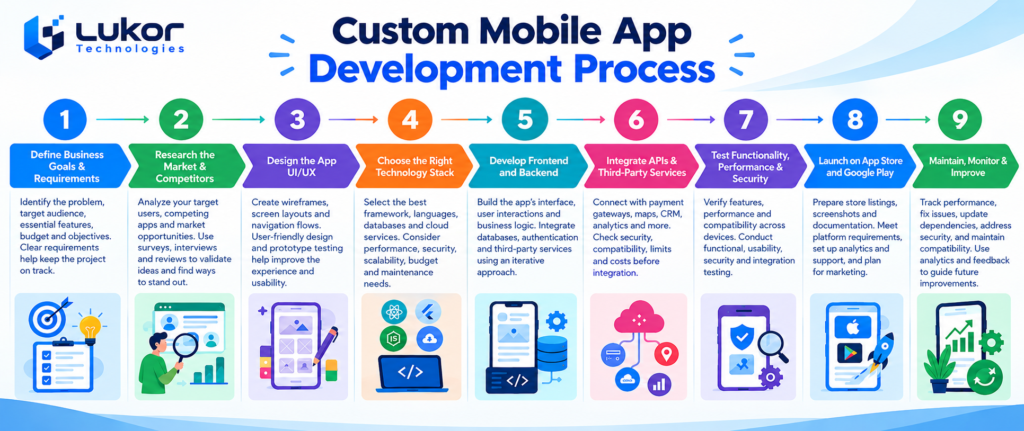
1. Define Business Goals and Requirements
Identify the problem your app will solve, its target audience, essential features, budget, and business objectives. Clear requirements help prioritize functionality, establish project scope, and avoid unnecessary development costs.
2. Research the Market and Competitors
Analyze your target users, competing applications, and market opportunities. User interviews, surveys, and competitor reviews help validate your idea, understand customer expectations, and identify opportunities to differentiate your app.
3. Design the App UI/UX
Create wireframes, screen layouts, navigation flows, and interactive prototypes before development begins. A user-friendly interface makes the app easier to navigate, while prototype testing helps identify usability issues early.
4. Choose the Right Technology Stack
Select suitable programming languages, frameworks, databases, backend services, and cloud infrastructure. The choice between native and cross-platform development should depend on performance requirements, target platforms, scalability, budget, and long-term maintenance.
5. Develop the Frontend and Backend
Frontend development focuses on the app’s interface and user interactions, while backend development manages business logic, databases, authentication, and server-side operations. Building and reviewing features incrementally helps teams identify issues and incorporate feedback throughout development.
6. Integrate APIs and Third-Party Services
Connect the application with external services such as payment gateways, maps, CRM platforms, analytics tools, and cloud storage. Before integrating these services, evaluate compatibility, security, documentation, usage limits, and ongoing costs.
7. Test Functionality, Performance, and Security
Test the app across supported devices and operating systems to verify reliability, usability, and security. Key activities include functional, compatibility, performance, integration, and security testing. Resolving issues before release helps deliver a more stable user experience.
8. Launch on the App Store and Google Play
Prepare app store listings, screenshots, privacy information, and required documentation. Verify that the application meets the relevant platform requirements, configure analytics and crash monitoring, and establish customer support. App Store Optimization (ASO) and marketing can help improve visibility after launch.
9. Maintain, Monitor, and Improve the App
Mobile app development continues after launch. Monitor performance, fix bugs, update dependencies, address security vulnerabilities, and maintain compatibility with supported operating systems. User feedback and analytics help identify improvements and guide future feature development.
Following these nine steps helps businesses turn an idea into a reliable mobile application that supports their objectives and adapts to changing user needs.
How Much Does Custom Mobile App Development Cost?
The cost of custom mobile app development typically ranges from $10,000 to $200,000 or more, depending on the app’s complexity, features, platform requirements, integrations, security needs, and ongoing maintenance. Enterprise applications with advanced workflows or specialized compliance requirements may require a significantly larger investment.
Understanding the estimated cost for each project type helps businesses plan their budgets and prioritize essential features before development begins.
Custom Mobile App Development Cost by Complexity
| App Complexity | Estimated Cost (USD) | Typical Scope |
|---|---|---|
| Simple | $10,000–$40,000 | Basic features, standard screens, and limited integrations |
| Medium | $40,000–$100,000 | User accounts, backend services, APIs, and advanced workflows |
| Complex | $100,000–$200,000+ | Advanced integrations, complex business logic, and demanding security or scalability requirements |
| Enterprise | $200,000+ | Large-scale systems, multiple integrations, specialized compliance, and extensive business workflows |
These figures are illustrative planning estimates, not fixed market prices or guaranteed quotes. Actual development costs may fall outside these ranges depending on project requirements, team location, technology choices, and delivery scope. A discovery assessment can help establish a more accurate estimate.
What Factors Affect Mobile App Development Costs?
Several factors influence the total cost of building a custom mobile application.
- Feature complexity: Basic applications generally require less development effort than apps with real-time tracking, video communication, AI-powered functionality, or complex payment workflows.
- Platform selection: Developing for iOS, Android, or both affects development, testing, and maintenance requirements. Cross-platform frameworks such as Flutter and React Native may reduce duplicated work when appropriate for the project.
- UI/UX design: Custom interfaces, animations, accessibility requirements, and usability testing can increase design costs.
- Backend development and integrations: APIs, databases, cloud infrastructure, payment gateways, and third-party systems add to the engineering effort.
- Security and compliance: Applications handling sensitive information may require additional security controls, privacy measures, and industry-specific compliance work.
- Ongoing maintenance: Hosting, monitoring, technical support, security updates, and future enhancements contribute to costs beyond the initial launch.
How Can Businesses Manage Mobile App Development Costs?
Businesses can manage their budgets by defining a minimum viable product (MVP), prioritizing essential functionality, and introducing additional features in stages. Choosing suitable technologies, documenting requirements clearly, and agreeing on deliverables before development begins can also help reduce unnecessary rework.
It is equally important to plan for post-launch expenses, including infrastructure, third-party subscriptions, bug fixes, and compatibility updates.
Ultimately, the right mobile app development budget depends on the business objectives, target users, and functionality required. Working with an experienced development partner to assess requirements, technical constraints, and long-term support needs can help businesses establish a realistic budget and development roadmap.
How Long Does It Take to Develop a Custom Mobile App?
Custom mobile app development typically takes 2 to 12 months or longer, depending on the app’s complexity, features, platform requirements, integrations, and testing needs. The development team’s experience, project scope, and speed of decision-making can also affect the timeline.
Typical development timelines include:
| App complexity | Estimated timeline | Typical scope |
|---|---|---|
| Simple app | 2–4 months | Core features, basic interface, limited integrations |
| Medium-complexity app | 4–7 months | User accounts, backend services, APIs, and advanced workflows |
| Complex app | 7–12 months or longer | Complex business logic, multiple integrations, advanced security, and scalability requirements |
These timelines are illustrative estimates, not guaranteed delivery dates. Actual schedules vary depending on project requirements, team size, and technical complexity.
What Affects Mobile App Development Time?
The main factors that influence development time include:
- Feature complexity: Advanced functionality requires more design, development, and testing.
- UI/UX design: Custom interfaces and usability testing can add time to the project.
- Platform selection: Building separate native apps for iOS and Android may require additional development effort.
- Third-party integrations: Payment systems, APIs, and existing business software can increase implementation and testing time.
- Testing and security: Device compatibility, performance, and security testing are essential before launch.
- Scope changes: New requirements or delayed approvals can extend the schedule.
Businesses can help keep custom mobile app development on track by defining clear requirements, prioritizing a minimum viable product (MVP), reviewing progress regularly, and limiting unnecessary scope changes.
The best way to estimate your app development timeline is to define the required features, select the appropriate technology, and establish a realistic project plan before development begins.
Which Technologies Are Used for Custom Mobile App Development?
The right technology stack depends on the application’s purpose, required functionality, team expertise, integration needs, and long-term maintenance strategy.
iOS App Development
Swift is a widely used programming language for building modern iOS applications. Apple’s development tools support interface design, debugging, testing, and integration with platform capabilities.
Native iOS development may be appropriate when an application needs a highly tailored Apple-platform experience or specialized device functionality.
Android App Development
Kotlin is a popular language for native Android development. Android’s development ecosystem supports applications across a broad range of devices, screen sizes, and hardware configurations.
Android projects should account for device compatibility, supported operating system versions, performance, and accessibility.
Cross-Platform Frameworks
Flutter and React Native are widely used frameworks for cross-platform mobile application development.
- Flutter: Uses Dart and provides a framework for building applications across multiple platforms.
- React Native: Uses JavaScript or TypeScript with React-based development concepts to create native mobile user interfaces.
Both can be effective choices, but neither is automatically best for every project. Teams should evaluate platform-specific requirements, available libraries, performance expectations, and developer expertise before making a decision.
Backend Technologies and Cloud Services
The backend manages data, business logic, authentication, APIs, and communication between the application and other services.
Depending on project requirements, teams may use technologies such as Node.js, .NET, Python, Java, or other backend platforms, supported by relational or NoSQL databases.
Cloud services can provide hosting, storage, monitoring, and infrastructure that scales with demand. The final architecture should balance reliability, security, performance, operational complexity, and cost.
What Features Should a Custom Mobile App Include?
Essential mobile app features depend on the application’s purpose and target audience. Rather than including every available feature, businesses should prioritize functionality that improves the user experience or supports a measurable business objective.
User Registration and Authentication
Registration and authentication allow users to access personalized services and protected information.
Depending on the application, options may include email verification, secure password management, social sign-in, or multifactor authentication. The design should balance account security with a straightforward onboarding experience.
Push Notifications
Push notifications can communicate relevant updates, reminders, order statuses, and service announcements.
Businesses should make notifications useful and timely, respect user preferences, and avoid excessive messaging that may encourage users to disable notifications or uninstall the application.
In-App Payments
Payment functionality enables users to purchase products, pay for services, subscribe, or complete transactions within supported workflows. For businesses building financial applications, fintech app development also requires careful planning of payment integrations, transaction security, and regulatory requirements.
Implementation requirements depend on the business model and platform rules. Payment systems should be selected with attention to security, transaction reliability, fees, and applicable requirements.
Search and Personalization
Search, filters, recommendations, and personalized content help users find relevant information efficiently.
An eCommerce app, for example, might offer product filters and recommendations based on permitted user preferences or shopping activity.
Personalization should be transparent and should respect applicable privacy requirements.
Analytics and Reporting
Analytics help businesses understand user behavior and evaluate whether the application is meeting its objectives.
Useful measurements may include active users, retention, conversion rates, feature adoption, session performance, and completed transactions.
Tracking should be configured thoughtfully, with appropriate consent and privacy controls where required.
Security and Privacy Features
Security should be incorporated into the application architecture and development lifecycle.
Depending on the use case, important measures include encrypted communication, secure credential storage, access controls, input validation, appropriate session management, and regular dependency updates.
Businesses should collect only the data they need, explain how information is used, and establish suitable retention and deletion practices.
What Are the Common Challenges in Custom Mobile App Development?
Even well-planned projects can encounter technical, operational, and business challenges. Identifying these risks early helps teams make informed decisions.
- Changing requirements: New features introduced during development can affect scope, cost, and delivery dates. A documented roadmap and change-management process help control unexpected expansion.
- Choosing the wrong technology: A framework that does not suit the application’s requirements may create performance issues or increase long-term maintenance effort. Technical decisions should follow a clear assessment of business needs.
- Integration complexity: External systems may have limited APIs, outdated documentation, usage restrictions, or inconsistent data. Early integration testing helps identify these problems before launch.
- Security and privacy risks: Weak authentication, insecure data handling, and outdated dependencies can expose users and businesses to risk. Security reviews and ongoing maintenance are essential.
- Performance and compatibility: Differences in devices, operating systems, network conditions, and screen sizes can affect reliability. Testing should cover the environments that matter most to the target audience.
- User adoption: A technically sound application may still struggle if it does not solve a meaningful problem or offer a compelling experience. User research, usability testing, onboarding improvements, and ongoing feedback can support adoption.
A practical way to reduce these risks is to start with validated requirements, build incrementally, test continuously, and monitor results after launch.
How Do You Choose the Right Custom Mobile App Development Company?
Choosing the right custom mobile app development company helps businesses build reliable applications, manage project costs, and plan for long-term growth. Before making a decision, evaluate the provider’s experience, technical expertise, communication, pricing, quality assurance, and post-launch support.
1. Review Experience and Portfolio
Examine previous projects that match your industry, features, or technical requirements. Look for relevant expertise, well-designed applications, and evidence of how the team addressed project challenges.
2. Evaluate Technical Expertise
Ensure the team has experience with the required platforms, frameworks, backend technologies, APIs, and security practices. Choose a development partner whose technical capabilities align with your application’s complexity and future needs.
3. Assess Communication and Project Management
Ask how the company manages milestones, progress updates, feedback, and scope changes. Clear communication and defined responsibilities help prevent misunderstandings and keep development organized.
4. Compare Pricing and Project Scope
Request a detailed proposal covering deliverables, timelines, payment terms, exclusions, and potential additional costs. Compare proposals based on scope, technical quality, and long-term value rather than choosing solely on the lowest price.
5. Check Testing and Security Practices
Ask how the team handles functional testing, device compatibility, performance, and security. A clear quality assurance process helps identify defects before release and supports a more reliable user experience.
6. Confirm Code Ownership and Ongoing Support
Clarify contractual ownership and access to source code, designs, documentation, and other project assets. Discuss maintenance, bug fixes, security updates, and technical support after launch.
The right custom mobile app development partner should understand your business goals, communicate technical decisions clearly, provide transparent pricing, and offer a realistic plan for development and ongoing maintenance.
What Is the Future of Custom Mobile App Development?
The future of custom mobile app development is being shaped by artificial intelligence, automation, cloud computing, and growing demand for personalized digital experiences. According to SNS Insider, the mobile app development market was valued at $145.05 billion in 2025 and is projected to reach $776.9 billion by 2035, growing at a compound annual growth rate (CAGR) of 18.25%.
As businesses continue to invest in digital transformation, custom mobile applications can help them streamline operations, improve customer engagement, and adapt to changing market demands. Technologies such as AI-powered recommendations, intelligent automation, and cloud integration are creating new opportunities to build more responsive and scalable mobile experiences.
For businesses planning a new application, the priority should be to solve real user problems, choose suitable technologies, protect user data, and plan for future growth. A well-designed custom mobile app can support evolving business requirements while delivering lasting value to customers.
Conclusion
Custom mobile app development helps businesses create digital products aligned with their specific requirements, customer expectations, and long-term objectives. From selecting the right technology stack to planning features, managing development costs, and maintaining security, every decision contributes to the application’s overall success.
A structured development process begins with clear business goals, validates user needs, prioritizes essential functionality, and improves the product through testing and feedback. Choosing the right development partner is equally important for managing technical complexity and supporting the application after launch.
Before starting a project, define the problem your app will solve, identify the features users genuinely need, establish a realistic budget, and choose a technology approach that supports future growth. With careful planning and continuous improvement, a custom mobile application can become a valuable part of your business strategy.
Frequently Asked Questions
1. What Is the Difference Between Custom and Off-the-Shelf Mobile Apps?
Custom mobile apps are built around specific business requirements, while off-the-shelf applications provide prebuilt functionality for a broader audience. Custom solutions offer greater control over features and integrations, whereas ready-made software may be faster and less expensive to adopt initially.
2. Is Custom Mobile App Development Worth the Investment?
Custom mobile app development can be worthwhile when an application addresses a validated business need, improves an important workflow, or provides value that existing software cannot adequately deliver. Businesses should compare expected benefits with development, operating, maintenance, and support costs before investing.
3. Can One Custom Mobile App Work on Both iOS and Android?
Yes. Businesses can use cross-platform frameworks such as Flutter or React Native to build applications for iOS and Android with a shared codebase. Some platform-specific development may still be required, depending on the application’s features and technical requirements.
4. Who Owns the Source Code of a Custom Mobile App?
Source code ownership depends on the contract and applicable law. Businesses should clearly establish ownership or licensing rights for the source code, designs, documentation, and other deliverables before development begins.
5. How Much Does It Cost to Maintain a Mobile App?
Maintenance costs vary according to application complexity, infrastructure, support requirements, security updates, third-party services, and the frequency of new releases. Businesses should establish a maintenance budget during initial planning instead of treating maintenance as an unexpected post-launch expense.
6. How Can a Custom Mobile App Generate Revenue?
A custom mobile application can generate revenue through direct purchases, subscriptions, transaction fees, in-app purchases, advertising, or paid services. The right model depends on the audience, industry, product value, and willingness to pay.